Thursday, January 17, 2008

The Three That Got Away, and a Successful Transfer

The TAG team had some fresh faces on the water these past two days. Nathan Taylor, a post-doc from the University of British Columbia, and myself, Gareth Lawson a post-doc out at Stanford, arrived on Sunday night to help out with the tagging. Both of us have been working on the TAG dataset for some time, and were eager to meet our study species face-to-face.

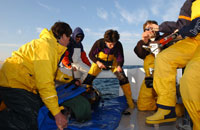
After waiting out some bad weather on Monday, come 5am Tuesday we were out on the Sensation with Captain Dale Britt, mate Will Johnson, and veteran TAGgers Andre Boustany and Gaelin Rosenwaks. Things got exciting quickly, when at 7:30 we hooked three fish within seconds of one another – a triple header! One fish shook off its hook after just a minute. I hopped into the fighting chair and we started battling the second one. This was my first time reeling one in, and it felt big. After a half hour of fighting we had got it up to the boat on a couple of occasions, but it was just too strong and kept pulling back away from us, until finally it broke the leader. Will got a good look at it and reckoned it was over 90 inches. Not a bad size for my first experience in the chair! Like the TAG team has seen on previous days, this is the trade-off in using light leaders – the lighter line is harder for the fish to see making it easier to catch them, but also easier for them to break off.

Nathan then got in the chair to bring in the third fish, but that one unfortunately pulled off its hook after only another few minutes. So sadly all three fish got away, and we didn’t deploy any tags.

On Wednesday the weather was again favorable and we were back on the water. Veteran TAG vessel the Leslie Anne had arrived in Beaufort the day before and was out fishing with us, led by Captain Gary Stuve along with seasoned TAG members Doug Roberts and John Rafter, and newcomer Flash. Neither TAG vessel caught any fish, although the Leslie Anne did have one fish show some interest in their bait.

Mid-morning on the Sensation, we got word on the radio that one of the boats in the commercial fleet had caught a fish that was ‘short’ (ie smaller than the legal minimum size of 73 inches) that they therefore wanted to transfer to us. It’s a very reasonable exchange, since we get a fish to tag and they get a $200 fuel voucher. The transfer involved us throwing over a tennis ball attached to the end of a line. They then clipped their leader (with the fish at its end) to the line and we got to work on reeling it in. For a small fish it certainly put up a big fight. They caught it on a long and light leader, so Will had to be particularly careful wiring it in and it took a few tries. We got it onto the boat though and after a successful tag surgery the fish swam away strongly. It measured out at 69 inches, small by some standards, but still the biggest (and only) bluefin that Nathan and I have ever seen!

Tuesday, January 15, 2008

More Bluefin Tagged


Well, we tagged a couple more bluefin this weekend and missed our chance at two others. It was a Duke University all star weekend as we had two boatloads of folks from Durham joining us on the water. On Saturday the 12th, we were joined by Mary Turnipseed, Meredith Barrett and Lucas Joppa, all graduate students at Duke, and Franklin Miller, an undergraduate. In addition, Gaelin Rosenwaks, who has been tagging with us for years, made a guest appearance, traveling down from New York City. The seas were a bit rough but we hooked up to a nice fish at about 9:30. Franklin fought it about 40 minutes before we lost it at the back of the boat. We got a couple of good looks at it and it looked like a nice, big fish. Aren't they all huge when they get away? Undeterred, we soldiered on and were rewarded with another hook up at about noon. We didn't miss this chance and ended up bringing this fish aboard. This one measured 197 cm (78 inches). After a quick surgery, this fish departed the Sensation with a brand new archival tag. He'll be the popular fish in his school, for sure!


On Sunday, another group from Duke's main campus made the lovely trek down from Durham to join us on the water. Joe Sexton, Ted Gilliland Franklin Miller and Lisa Pokorny joined the tagging team for an exciting day of chasing the elusive bluefin. Like the day before we hooked up to a nice fish in the morning but lost it before we could get the fish aboard. We made the switch to lighter leaders the previous week to increase the number of bites but, of course, that always increases the risk of broken leaders. We were definitely getting more strikes but the lost fish are always a disappointment. Not all hope was lost, though and we were delightfully surprised when we caught a little bluefin (134 cm) that was mixed in with the larger fish. This one is now also the proud owner of the latest in archival tagging technology.


Just wanted to say thanks to all who joined us out on the water this weekend. We appreciate the help. It wasn't the best weather conditions but nonetheless, the terrestrial biologists were green with envy when they saw how exciting the world of marine biology could be!

Saturday, January 12, 2008

Another Bluefin Swimming with Tags


The Tag team sat out one day as a cold front came in- and we were back out at the shad boat buoy area Thursday aboard the F/V Sensation and tagged and released a bluefin tuna that measured 82 inches. This fish was tagged by Dr. Andre Boustany with a pop- up satellite and archival tag. Thats close to $5000 of electronic equipment on one fish. We were fortunate to get a fish as only 7-8 were landed with a fleet of over 40 commercial boats. The electronic tags will provide information on where the bluefin tuna go after wintering in the Carolinas by recording sunrise and sunset information along with accurately keeping time. Its quite an engineering effort to do this- 17th century Astronomy algorithms running on 21st century tags- all inside the body of a bluefin tuna- if he or she only knew. The pop-up satellite tags (PAT) we're putting out are scheduled for pop-off at 210 days to 270 days- the archival tags are capable of measuring where a bluefin goes for over 5 years- this latter implantable tag requires retrieval- and we mark the fish with two very bright green conventional tags that points out to a fisher with Green- that there is a $1000 reward for recapture. Because there has yet to be an NC recapture- the first ever bluefin recpatured in NC has years of prizes riding on it- including a trip to Monterey! The PAT satellite tag should allow enough time to examine where the bluefin goes to breed. One major question in bluefin tuna biology is how old is a fish that goes to spawn? To date, we've found we have to tag bluefin tuna in North Carolina that are primarily above 94 inches to ensure the bluefin tuna tagged will end up in the Gulf of Mexico. We've seen one fish of 8 years of age from Carolina go there- but most of our fish from this winter fishery- or from the North- who end up in the Gulf of Mexico- are closer to 12 years of age. The fish we measure in North Carolina are 74 to 94 inches with just a few above 100 inches. Thus far this year - the bluefin that we're tagging are in the typical range of sizes (8-10) years of age- a few fish smaller (6 years of age) and a few fish slightly older (12 years of age) are also here. We have hypothesized that many of these fish are adolescents a year or two prior to going to the Gulf of Mexico, and some of these fish are Mediterranean breeders- others wander to the Bahamas or offshore Gulf Stream waters to the southwest where they may also potentially breed. Up in Canada earlier in the year we primarily tagged very large fish- that measured 108 inches to 125 inches. We think most will go during the spawning season to the Gulf of Mexico. Here in North Carolina we're taking genetic samples to confirm the assignment of the fish to populations (Gulf or Med). If this year is like the prior years- we'll find many of the Carolina bluefin are migrants from the Mediterranean who came over as juveniles - grew up on our shores, and will head back in a year or two. I am posting two tracks- one of a western origin track- a fish that was tagged in North Carolina and went to the Gulf (this fish was quite large)- and a fish that went to the Med from North Carolina. We don't know if these schools of Gulf and Med fish stay discrete while foraging or are completely mixed- but what we do know is this-bluefin from both origins are here- being landed. There are many questions remaining to be addressed. My favorite is just why are bluefin here at this location- Cape Lookout? More about this later- Barb

Wednesday, January 9, 2008

Bluefin Bite Slows Down


Well- after a wonderful few days- the bite totally shut off in the waters offshore of Cape Lookout. A large number of boats plied the waters off Cape Lookout- trolling everything from Ballyhoo to mackerel in conditions that looked ideal in spots- plenty of shad, diving gannets, spotted dolphin, whales, you name it we saw it- only one thing was missing- the bluefin tuna. The TAG team riding aboard Dale Britt's Charter boat Sensation- had a wonderful nature tour and we even caught and released an enormous Cobia - but other than this we hooked nada. This season there seems to have been a pattern- of cold fronts coming through- and a significant bite, that shuts off a few days after the pass of the front. Its so calm here now that the clarity in the water is most likely an issue- as you can see the lines and the terminal tackle with ease- stealthy fishing is a must with these grand predators who have warm eyes- and super vision. I believe there is much we still don't understand about bluefin in these waters. Some significant weather is coming in- so we'll most likely be off the water for a few days. We're collecting samples at all the bluefin landings point where the community has been super helpful enabling the TAG team to get samples for genetics and otoliths (earbones). Its quite a site to see Dr. Andre Boustany to remove these tiny earbones that literally have the natal signal of where the fish were born (Gulf of Mexico or Med) locked up in the bone. We hope to get out again and continue the electronic tagging shortly but after five days on the water its great to get a break. I am posting a few photos of mate Dave and angler Mike cranking on a large 90 inch fish several days ago on our tagging vessel Sensation that we released- and shots of two bluefin that Dr. Pat Halpin of Duke, Dr. Andre Boustany (at the head irrigation) and Barb (in blue) released with both archival and satellite tags being implanted (externally and internally). Andre made a super save on a hook that had lodged all the way in the stomach- and he easily removed it but did receive a significant abrasion. The fish swam away strongly. The weather is almost summer like here today- and I think we'll need another cold front to get the fish actively biting again. Barb

Monday, January 7, 2008

Calm Weather and Bluefin Bites

For the 4th day- spectacular calm oily seas and warm temperatures
have been coupled with a showing of bluefin. The commercial
fleet looked like a super highway- and fish were cut off as quickly as they
were on today- we had a double- but unfortunately a novice boat handler cut
off both fish- by crossing across the lines. The fleet had a 104 inch fish-
and large fish in the 90 inch year class appeared again at the docks. The fishing in the past few days is similar to 2005 and prior years- but we'll have to wait to see if it holds. We're heading out early tomorrow in hopes of getting a bite prior to the sun coming up! Tightlines- Barb

Sunday, January 6, 2008

TAG A Giant 2008 Is Here!

We are back in our favorite spot- Morehead City/Beaufort North Carolina and once again TAG is on. Our team had a successful day today tagging three fish- with archival tags and two double tagged fish with Satellite tags and archival tags (both in or on the same fish!). It was a spectacular calm day- a fleet of boats is here- commercially fishing and weekend warriors with permits to catch bluefin, and with the limit at 3 fish a day- we saw some extensive action on bluefin- over 35 fish were landed commercially - and at least 3- were released! The highlight of the day was catching aboard the TAG boat Sensation our first 2 fish of 2008, a 89" beauty and a slightly smaller second fish that with the water clarity very high- gave us a bluefin "show" that was worth the trip. We also were very lucky this morning to get a "Transfer" of a bluefin (a smaller fish) that was released from a commercial boat to our team for tagging! Quite a day- and we hope that tomorrow will continue the trend. We're at the TAG team count of 978 tags and of course- we're headed for the magic 1000! Pictures show Drs. Barbara Block, Andre Boustany and Pat Halpin tagging tuna along with Angler Mike, And Mate Dave all aboard Captain Dale Britt's vessel. Tightlines to all- Barb

Wednesday, November 7, 2007

First Data From Canada!

The first pop-up satellite archival tag (PAT) deployed last month in Nova Scotia popped up right on schedule and we now have data giving us a preliminary glimpse into the behavior of giant bluefin tuna up in those cold northern waters. This tag was programmed to release from the fish after only three days, and the fish was tagged with a longer-term PAT as well. These tags are primarily used as survivorship tags to garner information on where the tagged fish have moved to post-handling at the vessel during tag and release operations.

As you can see from this map, this fish which we measured to be 272 cm in length (translating to 339 kg or 747 lbs in weight) moved a little way north up the Cape Breton coast in the three days between when we tagged it and when the tag popped up. We’re eager to see where it will move to by the time the longer-term tag we also attached to it pops up!

In addition to giving us a highly accurate measurement of the location where the tag popped off, the PAT tag transmits to satellites data on the depths and temperatures that the fish occupied, which tell us a great deal about the behavior of the fish. In the graph below you can see the temperatures and depths the fish experienced over the course of the three day deployment. The y-axis (i.e., the vertical axis) on the graph shows depth, while the x-axis (horizontal) indicates date. Water temperature is then shown via the color scale, with red temperatures indicating warmer waters and blue indicating colder. What you can see is that there is a region in the water column from the surface to about 30 m in depth where water temperatures are relatively constant at around 13C because the water in this layer is well-mixed. Below this mixed layer is a region referred to as the thermocline where temperatures drop rapidly. You can also see that the depth of the thermocline became slightly shallower over the course of the three days as the fish swam northwards.

This next graph shows the proportion of time during which the fish was in waters of particular temperatures. You can see that it spent most of its time in the 12-14 degree waters of this mixed layer and only spent a small proportion of each day in the colder and deeper waters of the thermocline. We think what it's doing is hanging out in the warmer waters of the mixed layer that it finds more comfortable, making only brief forays into the colder waters below to feed on the prey that must be found there. As we get more data back from the longer-term tag attached to this fish, and from the other fish tagged in these Nova Scotian waters, well learn much more about how the fish behave in this cold water region.