Tuesday, October 3, 2017

Must be October

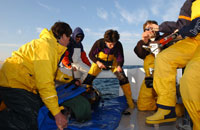
The TAG team had one of the most incredible runs in their 10 year plus Port Hood tagging history...six days straight on the water is almost unheard of in The Maritimes this time of year...and tagging Canadian bluefin in shorts and flip flops was previously incomprehensible. The best part was the fish were biting and we were able to deploy 25 electronic tags on multiple cohorts of giants.

The weather has kept the team on shore for a bit, allowing us to catch up on data entry, tag programming and most importantly laundry. We did manage a half day and discovered that the fish are still close by and still biting as we hooked four more fish in under 6 hours!

Troy Cameron cranks on a giant bluefin tuna


Capt. Dennis Cameron locks eyes with a bluefin

Capt Lloyd MacInnes positions the Bay Queen IV for tagging

Capt Dennis and his nephew Troy Cameron battle a bluefin

Natalie Arnoldi takes a fin clip from a fish for DNA analysis

Dr. Steve Wilson, Tom Horton and Lloyd MacInnes get ready to release a tagged bluefin back into the Gulf of St. Lawrence

Friday, September 29, 2017

TAG Canada 2017: the first 72 hours

We arrived in Port Hood on the 19th September to kick-off the 2017 giant bluefin tagging season in the Gulf of St Lawrence, Canada. This year we are pop-up tagging to study movements and habitat use over periods of up to a year, as well as acoustic tagging. Acoustic tags have a life span of up to 10 years and emit an acoustic signal every minute or so. These signals can be “heard” by any listening stations that are in range (within half a kilometre or so) and can provide unrivalled data documenting repeat fidelity of Atlantic bluefin tuna to areas where acoustic receivers are present, such as the Gulf of St Lawrence. As these tags stay active on the fish for such long periods, we can estimate natural mortality rates for the species, which have been previously very tough to estimate. Once incorporated into fisheries models, by combining with ‘F’ (fishing mortality), our hope is that this will further bolster efforts to accurately define annual population losses to help inform management.  

Although the tags are slightly different, our goal on the water is the same; catch and release bluefin tuna. Robbie Schallert and Tom Horton met with Dennis Cameron and Lloyd MacInnes on the morning of the 20th to get the Canada 2017 field season going, this was after hearing that the previous day there were 30 hook-ups in the fleet before 7am. The herring had already begun spawning near Port Hood. 

A charter boat gets hooked up as some of the rest of the fleet look on.  


Dennis Cameron looking on as one of the herring boats hauls a net laden with fish just after dawn.

Craig Cameron has been a part of our tagging team in the past; this year he's knee deep in herring on his own boat

This means that bluefin arrive in the early hours to pick off herring that escape as the fleet haul their nets. It usually means good bluefin fishing, and our first day was no exception. We had our first bite at 9:30am and by the close of play we had lost one and released three with acoustic and pop-up tags. This included a 299cm fish, the third largest we have ever tagged. It’s always a real privilege to see a fish that has run the fisheries gauntlet and won for nearly two decades, and we were very happy to see it go back out the transom door with an acoustic tag.

Robbie, Tom, Dennis and Lloyd haul a 299cm bluefin aboard for electronic tagging.

After day three we are 9 fish tagged for 10 hooked up. So, a good start but plenty more work to do. We’ve certainly been blessed with some very un-Nova Scotia – like weather and were even on the boat in shorts yesterday. We’re sure that will change……  


A rare glint of sun off a bluefin tuna prior to tagging in the Gulf of St. Lawrence. 

Thursday, September 21, 2017

Two for One Tag Retrieval

Sitting in the office at Acadia University in Wolfville Nova Scotia, TAG scientists in California emailed that a MiniPAT pop-up satellite archival tag, that had been previously outfitted on a bluefin tuna, recently popped up just 5km offshore of Cape Breton in the Gulf of St. Lawrence. When this tag popped up it transmitted some of the data it had recorded since being placed on the tuna, but by retrieving the tag a whole suite of archived data – basically a complete record of the tuna’s activity since being tagged – could be collected. So with this tag popping up so close to the coast, retrieving it was worth a shot!

Once popped up, these tags begin to transmit their location to satellites which then pass the information along to the scientists who own the tags. With the location data coming in from the tag, going out to get it sounds easy enough, but in reality, spotting a tiny black ball with an antenna on top just floating along in the open ocean is no easy task.

With winds high on Friday and starting back up again Sunday, Saturday was our only opportunity of getting calm enough waters to have a chance at spotting the tag before it got caught in the current and was swept too far off shore for retrieval.

Friday afternoon, Dr. Aaron Spares, part of the coastal ecology lab at Acadia University, and I, a Master’s student, packed up and began the trip to Margaree Harbour in Cape Breton to meet John Lauchlin, the captain of ‘Keepin’ Tradition’. We arrived late Friday night and after a quick trip to the wharf it was right to bed to rest our eyes and prepare for an early morning start. Just before sunrise we set out to the last transmitted location which was about 5km off of Cheticamp Island. We could not have picked a better day; the waters were flat calm as the sun rose over the highlands and as we got closer to our location our eyes were peeled and ready to spot that tag.

Sunrise over the Cape Breton Highlands
Once at the last known tag location, we turned on the tag locator, which can pick up the transmissions from the tag and help us narrow in on the exact location. The tag locator measures the distance between you and the tag and uses a scale from 0 to 237 to tell you how close you are, with 0 being the farthest and 237 the closest. It’s like a big game of hot and cold and based on the numbers that the locator gives you, you choose which direction to head.

We received our first transmission from the tag as soon as we turned on the locator. With Aaron and I both relatively new with this equipment, as soon as we received a transmission we decided to start corkscrewing around that location to narrow in on the tag. After about an hour of this, with no head way, we realized that the range of tag reception must be larger than we first thought and we might be much farther away than expected. We decided to take the path of strongest reception and drive until we got significantly higher numbers. Reaching what we assumed to be a much stronger signal we began to slow down and narrow our search again only to run into the same problem. After another hour or so, we still weren’t any closer. As this point, a little bit frustrated, we chose the path of the last strong signal and headed in that direction until we got to almost max signal strength before we slowed down. By some luck – or our captain’s expert navigation skills – it seemed like once we picked a direction, that he basically drove directly to the tag!

Tag in the water
Upon reaching 237 (the strongest signal on the tag locator) we slowed right down and there it was, bobbing along just a few meters from the starboard side. Aaron noticed it about a second before I did and as we both kept an eye on it John pulled the boat right up beside it, grabbed the dip net, and just like that, we had the tag! After hours of what seemed like aimless and frustrating searching, it was all smiles, mixed feelings of excitement and relief, aboard the ‘Keepin’ Tradition’. 

John Lauchlin and Danni Harper happy to have found the tag
With the work done, Aaron and I sat on the bow as we steamed back to the wharf. The perfect weather seemed to bring everyone out on that beautiful Saturday morning. With a couple fin whales off the stern, a pod of pilot whales off the starboard side, and grey seals playing off the bow. It really was the perfect day on the water and Aaron and I took in every last bit of it before we had to make our way back on land.

Having finished up earlier than expected, we decided to stop in at Port Hood to visit some long time TAG team members en-route back to Acadia. Upon arriving at the wharf, Dennis Cameron, the fisherman who assists with tuna tagging, informed us of some exciting news. There were a couple of fishermen on their way back in with a tuna that was outfitted with a satellite tag! We couldn’t believe it, what were the chances, two tags in one day! And for me, having never seen a Bluefin tuna in real life, I was pretty excited.

As news of the tagged tuna spread, the wharf got busy, and so did Dennis who was in scattered communications with TAG’s Barb Block and Robbie Schallert in California about what to do about the tag and what samples to get from the tuna.
Tags on the tuna

Once the tuna arrived at the docks it was brought up and sure enough, securely attached beside the dorsal fins were a pop-up satellite tag and an acoustic tag. Everyone on the wharf was so interested in the tags and it was a great experience to share with them what the tags were, how they worked, and what information the scientists were getting from them.

Fisherman checking out the satellite tag
The tags and tethers were taken off the tuna and then it was into the ice house to be dressed. Dennis collected a variety of samples (muscle, liver, and ear bones called otoliths) that will provide great information coupled with the tracking data from the tags.

With the fish on ice, the excitement died down and Aaron and I parted ways with the crew in Port Hood to continue our scenic drive through Nova Scotia from the Cape Breton Highlands back to Acadia University.  

-Danni Harper

Saturday, October 1, 2016

Weekend Dozen

Tuna fishing can be one of the most frustrating sports in the World...there are times when you will spend days on the water and never see a fish...and there are other times that you will catch a fish but the hook will pull out or the line will chafe and break.


This weekend was not that weekend...with only two boats fishing for the tagging team...the F/V Bay Queen IV and F/V Nicole Brandy tagged and released 12 bluefin tuna on 16 hook-ups. To say the bite was hot is an understatement...the fish in the Gulf of St. Lawrence are large by anyone's standards, and the "small" fish are still over 500lbs. It takes almost an hour to fight these fish, so in two days we fought fish for over 12 hours (including the ones we lost). 


We had fish erupt all around the boat on multiple occasions...imagine twenty 800 lb tuna coming 6 feet out of the water only an arm's length away from the boat. Standing at the back of the boat, you actually got splashed by the jumping fish as they chased billfish (saury) from Cape George to Cape Breton.


Our last bite on Sunday came as the sun was setting...it was our 6th fish of the day...and as I reeled in the Huey bait...WHAM...double header! Double headers happen quite often in fishing, especially tuna fishing and it is quite exciting. However, when both fish are over 700lbs it can be quite difficult to get both fish back to the boat. The captain has to maneuver the boat to make sure the fish don't take all the line off the reel or that the fish cross and cut the lines. Captain Dennis continued to amaze as he flawlessly positioned the boat to ensure both fish were successfully tagged!

Double header


Monday, September 26, 2016

Fall and Herring

Lloyd fights his 9th fish of the day...in a waterspout!!
Capt. Bernie Chisolm passes off another one
TAG is back in Cape Breton to take advantage of one of bluefin tuna's favorite meals...Clupea harengus, aka the Atlantic herring. Herring are a pelagic species which form schools particularly during feeding and spawning periods. In the southern Gulf of St. Lawrence, herring spawn in the spring and fall. Fall spawning occurs mainly from mid-August to October at depths of 5 to 20 m. Eggs are attached to the bottom and large females can produce up to 360,000 eggs. Herring eggs also attract another one of bluefin tuna's favorite meals...Scomber scombrus, aka the Atlantic mackerel. The mackerel are there to eat the herring eggs...and so you have an large amount of prey, which in turn attracts a large amount of predators...from bluefin to pilot whales to seals.

The bluefin are in the Gulf of St. Lawrence to fatten up on herring and mackerel before making their long migration back to the Gulf of Mexico (or Mediterranean) to spawn.

In the first two days back on the water we have had 16 hook-ups!! And so a busy couple of weeks begins...just need some good weather!!

Pilot whales ball up some mackerel

Dr. Steve Wilson tags a bluefin tuna


Sunday, August 28, 2016

Canada 2016 Day 2

Bluefin tuna on the sounder!
Tagged fish being released

Dr. Steve Wilson showing his love for the fish
Robbie Schallert and Steve Wilson measure a bluefin tuna
The day started out windy, but by noon the sea had calmed down so the TAG team headed to the docks. We first jigged some live mackerel then joined 4 other boats just off Mabou Harbor. At first it looked like it was going to be a slow day, but around 3 pm the ocean erupted with tuna of all sizes. It didn't take long before the Bay Queen hooked up!

Canada 2016

The TAG season has begun in Port Hood, Nova Scotia. The team arrived to beautiful summer weather...Lloyd MacInnes even wore shorts on the boat...a first for Canada bluefin tagging.

Llyod MacInnes fights the first fish of the season
This is our 9th season in Canada tagging giant tuna and the 20th anniversary for the TAG program. We came a little earlier this season to advantage of the weather and ask new questions about how these fish migrate and utilize the Gulf of St. Lawrence.

There are many places to look for tuna between Nova Scotia and Prince Edward Island...the hole, the feathers, the shark fin, the bat and the ball, the bank, the red barn, the mines, etc. etc...and at the start of the fishing season we have to look around a bit to see where the fish are aggregating. The commercial season has begun and Captain Dennis has been fishing these waters for over 30 years, so we have a hint as to where to look.

After a couple hours the Bay Queen IV was hooked into her first bluefin of the tagging season. It was a nice round 500 pounder that got a Wildlife Computer satellite tag and a Vemco acoustic tag. The 2016 tagging season has started with a bang!
Dr. Aaron Carlisle releases  a tagged bluefin

Wednesday, July 6, 2016

Top of the Tagging Pacific Bluefin Tuna Learning Curve!

Barb and Robbie tagging a Pacific bluefin
The trip aboard the shogun reached new territory today as the team aboard hit historic high levels of excitement as we finally had the banner day we were working towards. Five times today we had explosive bites while Kite fishing on breezing schools of the largest Pacific  bluefin we have ever seen in the eastern Pacific. Captain Aaron and Angler Chalie Morito along with crew member Tyler and several others worked seamlessly as a team sighting school after school of large almost giant bluefin feeding at the surface. After hookup long fights pursued in heavy tackle culminating at the swim step where the Tag team took over and gracefully captured each fish in slings barely large enough to hold the fish. Four men lifted the fish to four on deck tackling over 300 lbs of lift. The TAG team handled the fish like in a pit stop- each fish came came into the tagging station and were double tagged then sent on their way. Fish were feeding on Red crabs and anchovy. The fish had DNA and RNA samples taken and swam away strong. Five fish over six hours were  tagged and he team felt a sense of accomplishment as the techniques worked out early in the week succeeded with enormous efficiency and success. By the end of the day all ten satellite tags aboard were out in the sea on the largest Pacific bluefin the team has ever tagged in the North Pacific.  This is terrific for our efforts to learn the exact timing of when the fish spawn. 

 -Barb

A large bluefin being double-tagged on the Shogun  deck


Tuesday, July 5, 2016

Archival Tagging Bluefin in Mexico!

The focus turned from tagging large bluefin with satellite tags
in  US waters to getting out surgically implanted archival tags in
high numbers today- and to help us achieve our mission- our Mexican
colleagues at Baja Aquafarms  of Ensenada, Mexico- contributed 32
fish ranging from 40 to 70  lb fish for tagging. We came to some tow
pens maintained by the famr early in the AM, that had beautiful f2016
captured fish circling-that had been caught about a month earlier.
The fish were already feeding and looked quite well. To catch the
fish we used lift poles- manned by two of the crew, and with the help
of their divers and some members of our team- we coordinated the
capture of the fish in a sling, the removal of the hook, and the
transfer to the archival tagging station. The entire operation took
less then two hours (30 fish tagged), and was orchestrated from start
to finish with well coordinated steps. Fish were caught on a barbless
hook by Charlie, Aaron and Renne, then moved to a sling manned by Dr.
Daniel Madigan. Dan managed to keep the fish in the sling with some
water along with two divers assisting and passed off the fish to
teammates waiting on deck led by Dr. Luke Garnder. Luke's team
managed to bring the fish to the tagging station and were greeted by
Drs. Dale and Block, and TAG scientist, Mr. Robbie Schallert.
Together this team placed a surgical archival tag in the fish, took a
sample of muscle for mRNA, and DNA samples, and completed the process
in quick succession 30 different times! All fish looked good and what
made the entire team happy- is that just as we pulled away from the
pens- the captain sited more wild fish- and we within the space of an
hour tagged a few more of the same size class in the pen. It was a
glorious moment- to get about 32 tags out- and all on 3-4 year old
fish. These tags will last up to six years in the wild taking high
resolution data. And have the promise of showing how these fish
mature- the ontogenetics of their changing behavior and the route to
the various spawning grounds. Their only fault is that we need to get
the tags back!

-Barb

Monday, July 4, 2016

The Pacific Bluefin Got Even Bigger!

On Independence Day 2016 the Tag team aboard the Shogun actually made some real history. We have struggled to learn how to capture tag and release the largest Pacific bluefin tuna we have seen in our lifetime and this day proved more successful then the previous two. Today aboard the shogun, a long range recreational fishing boat out of San Diego we were able to catch three Pacific bluefin that taped  twice on two fish to 184 cm (72-73 inch fish) above the 200 lb class of Pacific bluefin and get them to the swim step. Two of the three  fish were in excellent condition for double tagging with pop up satellite archival tags and an implantable archival tag went in surgically in both. The tasks were challenging for the team from the hook up on a kite with a surface bait to the fight on heavy stand up tackle in the open ocean.The coordination and capacity for our team to capture in a sling and lift a large fish and the water draining from the  sling to the deck for tagging. Led by Robbie Schallert of TAG and Dr  Luke Gardner of Stanford the men with help from many others were able to place the large fish in a sling and move it to the deck placed Mats for tagging.   Pacific bluefin older the six years of age hold a secret we want to know: Where and when do they breed in the Pacific. The excitement aboard the Shogun is that this is a challenging operation and we are succeeding and improving daily. Five of these large fish have been hooked  successfully and three to date tagged and one sampled intensively. These fish hold a secret to he life history of bluefin we all seek to understand. This tagging trip working out the techniques to handle large bluefin for this realm reminds me of our work over twenty years ago off North Carolina in 1996 when a small team from the TRCC went out with Captain Bob Eakes to figure out how to tag and release this similar class of fish on the east coast. From the 1996 work we went on to tag 1300 Atlantic bluefin most bigger then the fish we are working on today. Our goal as we go forward is to satellite tag the larger bluefin we can catch in the Pacific but it's very hard to access these large fish. 

But confidence grows from catching three and releasing two large Pacific bluefin on the fourth of July and we are all excited about what we are seeing. The fish are packed full of red tuna crabs and anchovy. More bait and whales and Albatross and shearwaters making a hot spot on tthis region of our blue Serengeti of the California Current. 


Barb

Friday, July 1, 2016

Bluefin Tuna Special

Our Pacific bluefin tuna tagging and collecting trip  is out in the Pacific aboard the Shogun a recreational long Range fishing boat we've used annually to do this trip. The objective of the cruise is to electronic tag Pacific bluefin tuna and study their migrations to the spawning grounds in the western Pacific. In addition we hope to collect 15 to 20!bluefin tuna for the TRCC lab to conduct feeding studies.   For tagging we use two types of electronic tags each with their target size of fish and story we hope to tell with the data  One type of electronic tag is a Pop up satellite tag that is programmed to stay on the fish for one year and potentially show us where the largest year classes go after foraging in the eastern Pacific hot spots. This is a hot question in current Pacific bluefin tuna science. The other type of tag is called an archival tag. These tags are programmed to last six years and will provide in depth data in what a bluefin does over the entire period In 10-20 second intervals. That would be immense data and to far we've successfully used these techniques up to three years in the Pacific and five years in the Atlantic. These tags are brand new and when we put them in fish off the shores of North America we hope to see them five to six years from now recaptured. They have the potential to record the daily position, thus the journeys and behavior in high resolution for the entire six years.  They carry three languages  and all say Return for Big reward.bit takes a fisher person to get the tag back. But we know this works to date we have 53 percent returned in the Pacific and about twenty percent in the Atlantic.  It takes a lot of international cooperation but we are hopeful as this type of tagging has given Atlantic and Pacific bluefin tuna researchers the most  detail required to increase our knowledge of when and where tuna spawn a critical question essential to life history and management questions. In addition these tags provide oceanography and behavioral data essential for better understanding the fish. 

Slow Bite but Big Fish😎

Today the first of July l, we got off to great start with the pop up satellite tagging of our first fish which by measurement is the largest fish we ever have tagged on the Shogun. The bluefin tuna was caught by a crew member and measured 177  cm in curved length. We estimate the fish was close to 190-200 lbs. 


We caught the fish using innovative techniques by the Shogun crew and met the challenge of lifting it on board from a swim step and satellite tagging the fish.   If the tag stays on (a problem for these fast moving fish) we hope to get a year of data on where the bluefin tuna go to spawn.  Fish of this size class are very hard to catch as bluefin tuna vision is extraordinary. We were able to catch two more bluefin tuna of a smaller size class well above the size we intend to collect and for our first day we ended with two archival tags and the largest fish ever in twenty years of TRCC tagging. Great start! 

- Barbara Block

Monday, November 2, 2015

A 20-Step Guide to Tagging Giant Atlantic bluefin

There’s a long list of things that have to go right to tag a giant bluefin tuna.  Here’s an abbreviated version.

To tag a giant bluefin tuna you have to:
1.) Obtain research permits, program and prepare the electronic tags, and pack a lot of gear (don't forget anything!!!).

2.) Travel to a remote corner of Nova Scotia.

Autumn colors on Cape Breton Island, Nova Scotia. photo: E. Estess
3.) Wait, and wait, and wait for the weather to clear up. We were only able to fish 7 days out of 3 weeks this October due to weather!

4.)  Make sure your tagging boat motor is working.

5.) Find and catch large mackerel for bait.

6.) Search for a school of bluefin tuna (this can take hours/days).

Diving gannets and busting bluefin. photo: E. Estess
7.) Get a bluefin to bite the bait. Bluefin are notoriously picky about what they will bite. Last week we had a school of giant bluefin jumping through our mackerel baits without a single hookup!

A bluefin nails the bait! photo: E. Estess
8.)  Make sure the circle hook sets in the corner of the tuna’s mouth.

9.) Fight the fish to the stern without pulling so hard that you break the straining monofilament or bend the small metal hook.

Lloyd MacInnes and Dennis Cameron work together to angle in a
large bluefin for the tagging team. photo: E. Estess
10.) Guide the head of the tuna to the back door of the tagging boat. This is one of the hardest steps as the tuna can easily shake its head and pull the hook, particularly when the seas are rough.

11.) Use 5 people to pull the (up to 1,600lb) animal through the back door of the tagging boat onto a padded surgical mat.

12.) Place a hose into the tuna’s mouth to irrigate the gills with oxygen rich seawater and place fabric over the animal’s eye to reduce stress.

An eye cover and irrigation hose help keep the bluefin calm
and safe on deck.  Photo: R. Schallert
13.)  Remove the hook from the corner of the mouth.

14.)  Measure the length of the fish. This length measurement can be converted to an estimate of the fish’s weight at a later time.

15.)  Insert sterilized titanium darts into precise locations along the tuna’s back to anchor acoustic and satellite tags securely to the fish.  If done correctly, the acoustic tags will last for up to 5 years and the satellite tags will automatically detach from the animal after 1 year. Note: All tagging and handling procedures are conducted under the strictest animal care protocols.

Dr. Steve Wilson places a satellite tag into the dorsal muscle of a
large Atlantic bluefin. Photo: E. Estess
16.)  Insert a conventional/spaghetti tag with the phone numbers to call in case the fish is recaptured by a commercial fisherman.

17.)  Take a small (pencil eraser-sized) clip of the tuna’s fin to use for DNA sequencing.  This will allow us to understand if the animal is from the eastern or western Atlantic population of bluefin.

18.)  Lift and rotate the surgical mat to point the tuna’s head out the door (easier said than done!).

The Tag-A-Giant team lifts a giant bluefin to release it back into
the Gulf of St. Lawrence. Photo: R. Schallert
19.)  Guide the tuna out the door and watch it kick away into the deep blue of the Gulf of St. Lawrence.

20.)  Exchange high 5’s with the team!

The weeks of preparation and decades of expertise between the fishermen and researchers paid off and we were able to tag and release two giant bluefin on this trip. Our past results have shown that a majority of these tunas swim south from the foraging grounds in Nova Scotia to the Gulf of Mexico to spawn, and a small percentage swim across the Atlantic into the Mediterranean Sea for lesser-known reasons.  Only through long-term tagging studies like this will we be able to understand tuna migration and life history in order to effectively model population sizes for stock assessment and sustainable management of this species. 

Follow this link to the recent publication of our 8-years of tagging effort in Nova Scotia:
http://www.tunaresearch.org/reprints/Wilson_et_al_2015.pdf