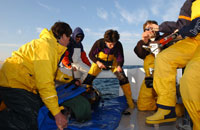
In addition to providing some amazing tagging opportunities, the TAG trip to North Carolina yielded some fantastic outreach work as well! The TAG team was joined by natural history videographer Bill Hitchcock, who got some fantastic footage of the tagging operation. And right after she returned to California, Barb got to do a live, in-depth radio interview with radio talk show host Lockwood Phillips on WTKF 107.1 out of Morehead City.
You can listen to a recording of the interview here.
Tuesday, January 20, 2009

Friday, January 9, 2009
El Tejano

<


Monday, January 5th the fishing luck at Morehead City was with the TAG-A-Giant team aboard the Tagging Boat Sensation. Our vessel was joined by a new member of the TAG team- the El Tejano (The Texan)- a beautiful Bertram from South Carolina owned By Mr. John Hill. John is board member of the Tag A Giant Foundation and a great champion of bluefin tuna. John’s team had never caught a giant bluefin aboard El Tejano, and came up Sunday after a 9 hour journey to join us in our efforts to place archival and pop up satellite tags on giant bluefin. We went out on a very nice Monday, after a slow Sunday for the TAG team but good bite for Morehead commercial fishers, and in the early morning dark it was clear, with a glance at the radar screen- we were not alone- 50-60 boats were right there, with us, angling to catch a bluefin to sell to Japan. The market prices had hit new highs over the holiday weekend. Fish in Morehead were going for big dollars and the fleet was focused on catching fish. In the pitch black of early am night- we got the call- “fish on” from the El Tejano team. It was almost as if we were hearing things. We were shocked- again- perhaps beginner’s luck or maybe the El Tejano team was just kidding when they said they had never caught a giant. So we quickly took in our gear- we had just put out- and plotted a course for the vessel. It was the still dark as we slowly moved toward the our team mates- I went over all the scenarios in my head of how we would do this- given it was dark and asked our mate Alan, if we had deck lights- we had Bill Hitchcock the camera man aboard too and it would be hard to capture the moment, let alone do surgery, without light- we did not have deck lights! Surgery in the dark is never easy. Luckily, dawn broke, and as we moved the 2 nautical miles or so over- to the vessel we politely nicknamed “El Taco”- finally we could see the action. Once we arrived it was amazing to see John Hill guiding the vessel and Dave his Captain in the chair. We had gone over with Charlie the mate- how to do a transfer less than 12h before and there he was with a wind on leader- trying his first transfer in the early dawn. After a few trying moments Charlie successfully transferred the fish and than it was ours and we were psyched because long time friend of TAG, former leader man- and Merchant Marine- Joey Smith was our angler. Joey brought the fish to leader- a strong fish – and Alan began his campaign to bring the fish in on 220# leader. It took about 15’ but sure enough we put the fish in the boat. The bluefin was lit up- you can see its bars above- as Andre irrigated the gills. I placed an archival tag into the fish- and within minutes we turned the fish around and sent him swimming amongst the fleet- It was a nice fish about 86 inches long. What a moment, all on film, our great supporter- John Hill and his team- Congrads to all for a fine TAG A Giant moment! There were only 3 bites this day- and it was great letting a big fish go- Barb
Thursday, January 8, 2009
TAG 2009 North Carolina


TAG 2009
January 3
The New Year brought us to North Carolina where we’ve been tagging bluefin since 1996. We arrived and found numerous commercial fishers reporting a very good New Year’s eve bite after some spotty commercial fishing for several weeks. Sure enough the TAG team went out with a flotilla of vessels helping tag fish inclusive of the TAG Boat (Sensation) captained by Dale Britt, the Annie C, the Gracious, and a beautiful sport fisher captained by Golf pro Curtis Strange. The team moved out to where the fleet had been fishing just west of the Cape Lookout Shoals. After a slow morning Captain Dale made a strategic decision and moved the team to a new spot. The Annie C reported they had fish on and the “mate” aboard was our former skipper of the TAG boat Calcutta, Mr. John Jenkins. We were very excited knowing John, knew the drill well having led the transfer effort throughout the 1990s and early part of this decade. We pulled up, he smoothly transferred the fish like a pro. Once at our vessel- the veteran crew relied on the sure leader handling by Sensation mate Alan of the Sensation to carefully work the fish- into the position so Dr. Andre Boustany could lip hook the fish. Once aboard the fish received an internally implanted Lotek archival tag. We put out our trolling lines once we settled back in- and the Bill Collector reported hooking up. As we trolled slowly towards the Bill Collector we saw an explosion of water on the surface. We headed in that directly and sure enough we hooked up on our down bait. It was our first fish of the year- and quite a story. Franklin, a Duke University 2007 graduate and strong angler, hopped in the chair and before long had the fish close to the boat- but the fish had other plans and took the line out several times prior to finally settling in for a long stand at the boat. Given we had to pull this fish into the boat- we needed this very strong fish to settle down a bit. After an almost 30’ Wait period of trying to pull the fish in and than relaxing and waiting- we were able to get the fish in position, put a lip hook in and drag fish into the boat. This fish was enormous for Carolina, 258 cm- over 100 inches! It turned out this was the second largest fish ever in the 800 plus fish we had tagged. We quickly put a pop up satellite tag in the fish with a 270 day deployment period- as we’re interested the exact timing of the migration into the Gulf of Mexico. We proceeded to move the fish off the vessel- had some issues trying to turn the fish around- as it was quite large specimen. Finally after some challenges we put the bluefin back in the ocean to swim again. It was remarkable first day of the year for tagging. We have it all on film as videographer and good luck charm- Bill Hitchcock put it all on tape for broadcast. Barb
January 3
The New Year brought us to North Carolina where we’ve been tagging bluefin since 1996. We arrived and found numerous commercial fishers reporting a very good New Year’s eve bite after some spotty commercial fishing for several weeks. Sure enough the TAG team went out with a flotilla of vessels helping tag fish inclusive of the TAG Boat (Sensation) captained by Dale Britt, the Annie C, the Gracious, and a beautiful sport fisher captained by Golf pro Curtis Strange. The team moved out to where the fleet had been fishing just west of the Cape Lookout Shoals. After a slow morning Captain Dale made a strategic decision and moved the team to a new spot. The Annie C reported they had fish on and the “mate” aboard was our former skipper of the TAG boat Calcutta, Mr. John Jenkins. We were very excited knowing John, knew the drill well having led the transfer effort throughout the 1990s and early part of this decade. We pulled up, he smoothly transferred the fish like a pro. Once at our vessel- the veteran crew relied on the sure leader handling by Sensation mate Alan of the Sensation to carefully work the fish- into the position so Dr. Andre Boustany could lip hook the fish. Once aboard the fish received an internally implanted Lotek archival tag. We put out our trolling lines once we settled back in- and the Bill Collector reported hooking up. As we trolled slowly towards the Bill Collector we saw an explosion of water on the surface. We headed in that directly and sure enough we hooked up on our down bait. It was our first fish of the year- and quite a story. Franklin, a Duke University 2007 graduate and strong angler, hopped in the chair and before long had the fish close to the boat- but the fish had other plans and took the line out several times prior to finally settling in for a long stand at the boat. Given we had to pull this fish into the boat- we needed this very strong fish to settle down a bit. After an almost 30’ Wait period of trying to pull the fish in and than relaxing and waiting- we were able to get the fish in position, put a lip hook in and drag fish into the boat. This fish was enormous for Carolina, 258 cm- over 100 inches! It turned out this was the second largest fish ever in the 800 plus fish we had tagged. We quickly put a pop up satellite tag in the fish with a 270 day deployment period- as we’re interested the exact timing of the migration into the Gulf of Mexico. We proceeded to move the fish off the vessel- had some issues trying to turn the fish around- as it was quite large specimen. Finally after some challenges we put the bluefin back in the ocean to swim again. It was remarkable first day of the year for tagging. We have it all on film as videographer and good luck charm- Bill Hitchcock put it all on tape for broadcast. Barb
Sunday, December 14, 2008
Carolina Bluefin Blues

TAG 2008
This is the time of year when the Carolina bluefin show- and the word so far is a few fish have made it down there, some big ones- but the show of fish thus far - is currently below the major years which we experienced- in the mid 1990s. Perhaps in January things will pick up. For the bluefin- I hope so- but I am getting worried.
For bluefin tuna 2008 has not been a good year as ICCAT the commission that is suppose to consider its scientific advice as it makes management quota decisions, has once again shown its unable to prevent overexploitaiton, overfishing, and the demise of Atlantic bluefin.
So much is at stake- the biodiversity of the species, the stability of the populations, the future of Atlantic bluefin as a species. I read a paper today entitled "Predicted extirpation of the dominant demersal fish in large marine ecosystem: Atlantic Cod in the Southern Gulf of St. Lawrence." It is in the latest issue of the Canadian J. of Fisheries and Aquatic Sciences Journal as a Rapid communication. Basically it says that even in the absence of all directed fishing, this animal, once the most prominent fish in the demersal ecosystem as late as the 1980s, has little chance of recovery. Extirpation was described as less than 1000t of spawning biomass, or less than 0.3% of the average spawning biomass in the 1950s. Elevated natural mortality seems to be the problem. It happens when there is a major shift in the baseline of the ecosystem, sort of the tipping point in the ecosystem- where now- so much has changed that the cod cannot recover. Why the cod cannot return here is complex but the basic premise is there are too few spawners- we took too many, and too few juvenile fish to prevent predation from replenishing the ranks
I often wonder how far we'll push the western bluefin tuna that spawn in the Gulf of Mexico- the fish I think of as true Giant Bluefin. I've been thinking a lot lately about what was the virgin biomass - of western bluefin when I was born. How far down are we now- and can the fish actually recover. I often wonder what folks 30 years from now will think of our generation of biologists, fisheries scientists, and managers. We have all the indications- we're moving beyond where we should be- into cod territory, for western Atlantic bluefin to recover, and eastern bluefin are following closely.
I only can retain hope for bluefin in the fact that our team from TAG A Giant has recently shown that the biodiversity in the genetics of the Gulf of Mexico bluefin suggests that if we stopped fishing today- we'd actually be able to retain significant genetic biodiversity from the original virign population- that is much of the original genetic biodiversity- is potentially still swimming on Earth today- in the great, great, grand children (3 or so generations removed) of the original virign Gulf of Mexico bluefin tuna (remember they have 30+ year lifespans, 12-14 year generation times, and it was only in the 1960s we began taking out all the spawners)- so, I believe- its still not too late. So we keep trying to put the facts on the table-paper after paper, and I agree with my countrymen- my local fishers from my native New England- that we do need Europe and Japan to start paying attention- to the fact that they are catching our recovery- that the consumer demand is too high. We too must also pay attention that the Last Giants ply our waters today- and every fish counts-for example how come we gave more quota in the Gulf of Mexico to western Nations. If we can't catch it thats OK- more spawners will make it. If you follow the cod trajectory this is not a good idea. So in this year of our much sought after 1000th Tag Event, and the remarkable new story on Otoliths we've published in Science in October, on how we use ear bones to provide evidence of the birthing place of individual fish- its time we hope that someone listens. Our North American stock is unique, we must do what we can to protect it.
Please Join Us - Sign Up in Support of TAG's team today: www.tagagiant.org
http://www.tagagiant.org/Donate.shtml
We need your help now to Ensure the bluefin's future! Better Yet come join us on the water in Carolina- In return for a donation you can fish with us aboard the Sensation with Captain Dale Britt
Thanks for all your support. Happy Holidays- Barb
This is the time of year when the Carolina bluefin show- and the word so far is a few fish have made it down there, some big ones- but the show of fish thus far - is currently below the major years which we experienced- in the mid 1990s. Perhaps in January things will pick up. For the bluefin- I hope so- but I am getting worried.
For bluefin tuna 2008 has not been a good year as ICCAT the commission that is suppose to consider its scientific advice as it makes management quota decisions, has once again shown its unable to prevent overexploitaiton, overfishing, and the demise of Atlantic bluefin.
So much is at stake- the biodiversity of the species, the stability of the populations, the future of Atlantic bluefin as a species. I read a paper today entitled "Predicted extirpation of the dominant demersal fish in large marine ecosystem: Atlantic Cod in the Southern Gulf of St. Lawrence." It is in the latest issue of the Canadian J. of Fisheries and Aquatic Sciences Journal as a Rapid communication. Basically it says that even in the absence of all directed fishing, this animal, once the most prominent fish in the demersal ecosystem as late as the 1980s, has little chance of recovery. Extirpation was described as less than 1000t of spawning biomass, or less than 0.3% of the average spawning biomass in the 1950s. Elevated natural mortality seems to be the problem. It happens when there is a major shift in the baseline of the ecosystem, sort of the tipping point in the ecosystem- where now- so much has changed that the cod cannot recover. Why the cod cannot return here is complex but the basic premise is there are too few spawners- we took too many, and too few juvenile fish to prevent predation from replenishing the ranks
I often wonder how far we'll push the western bluefin tuna that spawn in the Gulf of Mexico- the fish I think of as true Giant Bluefin. I've been thinking a lot lately about what was the virgin biomass - of western bluefin when I was born. How far down are we now- and can the fish actually recover. I often wonder what folks 30 years from now will think of our generation of biologists, fisheries scientists, and managers. We have all the indications- we're moving beyond where we should be- into cod territory, for western Atlantic bluefin to recover, and eastern bluefin are following closely.
I only can retain hope for bluefin in the fact that our team from TAG A Giant has recently shown that the biodiversity in the genetics of the Gulf of Mexico bluefin suggests that if we stopped fishing today- we'd actually be able to retain significant genetic biodiversity from the original virign population- that is much of the original genetic biodiversity- is potentially still swimming on Earth today- in the great, great, grand children (3 or so generations removed) of the original virign Gulf of Mexico bluefin tuna (remember they have 30+ year lifespans, 12-14 year generation times, and it was only in the 1960s we began taking out all the spawners)- so, I believe- its still not too late. So we keep trying to put the facts on the table-paper after paper, and I agree with my countrymen- my local fishers from my native New England- that we do need Europe and Japan to start paying attention- to the fact that they are catching our recovery- that the consumer demand is too high. We too must also pay attention that the Last Giants ply our waters today- and every fish counts-for example how come we gave more quota in the Gulf of Mexico to western Nations. If we can't catch it thats OK- more spawners will make it. If you follow the cod trajectory this is not a good idea. So in this year of our much sought after 1000th Tag Event, and the remarkable new story on Otoliths we've published in Science in October, on how we use ear bones to provide evidence of the birthing place of individual fish- its time we hope that someone listens. Our North American stock is unique, we must do what we can to protect it.
Please Join Us - Sign Up in Support of TAG's team today: www.tagagiant.org
http://www.tagagiant.org/Donate.shtml
We need your help now to Ensure the bluefin's future! Better Yet come join us on the water in Carolina- In return for a donation you can fish with us aboard the Sensation with Captain Dale Britt
Thanks for all your support. Happy Holidays- Barb
Wednesday, December 3, 2008
ICCAT: Another Year, Another Disappointment
The 2008 ICCAT meeting concluded last week in Marrakech, Morocco. The media had been buzzing about bluefin tuna in the weeks leading up to the meeting, particularly in regards to putting an end to the egregious level of illegal overfishing in the Mediterranean Sea. The European Union (EU), the most flagrant abuser of current regulations, said that “time is running out to save the bluefin tuna stock from collapse” and committed to “champion bold and decisive measures” at the meeting. Several nations, including Japan, proclaimed that without meaningful and resolute action by ICCAT, Atlantic bluefin tuna management would be transferred to CITES, the body that regulates international trade of endangered species – and a highly feared adversary of anyone involved in commercial exploitation of an animal or plant species.
Despite all the hype, by the time the dust settled in Marrakech, it was business as usual for ICCAT. The EU was up to its typical antics, maintaining a veil of secrecy on its eastern bluefin proposal until the final days of the meeting. Despite calls ranging from a moratorium, as suggested by an external review panel commissioned by ICCAT, to a 15,000 metric ton (MT) quota, as recommended by ICCAT’s own scientists, the eastern quota was only reduced from 27,500 MT to 22,000 MT for 2009, with a further reduction to 18,500 by 2011. Equally problematic, ICCAT also failed to close the Mediterranean spawning ground for the months of May-July as urged by scientists but instead extended the existing closure by a measly 2 weeks. There is some hope that the new regulations will improve compliance, which, if true, will be more meaningful than any potential quota reduction given the current level of illegal fishing. However, given the fishery’s current operating climate, we’ll believe it when we see it.
The western Atlantic quota was reduced from 2100 MT to 1900 MT for 2009 and 1800 MT for 2008, a change in line with the scientific advice. Yet another ICCAT meeting where our fishermen will follow the science, even if it's a sacrifice, and those in the East will ignore it. As part of the negotiations, Canada was assured transfer of U.S. and Mexican unharvested quota, which will likely result in a comparable harvest level for Canada (and perhaps the entire western Atlantic given recent U.S. underharvests). In a positive development, rollover of underharvest will be capped at 10% by 2011; if a population is so depleted that the allowable take can not be harvested, it is dangerous to add that unused quota to the following year, further threatening the population. The most alarming provision of the new regulations potentially opens a loophole for Mexico to increase fishing mortality on bluefin on the Gulf of Mexico spawning grounds. We are already working to reduce mortality in U.S. waters of the Gulf; this is no time to launch a new fishery in the western bluefin’s most critical habitat.
The U.S. and other Atlantic fishing nations have until June 2009 to implement the new regulations. Hopefully the media and stakeholder groups will keep bluefin in the spotlight and demand accountability. Given the lack of progress, preparations for a CITES listing will undoubtedly proceed in parallel to efforts to implement and enforce the new measures.
Despite all the hype, by the time the dust settled in Marrakech, it was business as usual for ICCAT. The EU was up to its typical antics, maintaining a veil of secrecy on its eastern bluefin proposal until the final days of the meeting. Despite calls ranging from a moratorium, as suggested by an external review panel commissioned by ICCAT, to a 15,000 metric ton (MT) quota, as recommended by ICCAT’s own scientists, the eastern quota was only reduced from 27,500 MT to 22,000 MT for 2009, with a further reduction to 18,500 by 2011. Equally problematic, ICCAT also failed to close the Mediterranean spawning ground for the months of May-July as urged by scientists but instead extended the existing closure by a measly 2 weeks. There is some hope that the new regulations will improve compliance, which, if true, will be more meaningful than any potential quota reduction given the current level of illegal fishing. However, given the fishery’s current operating climate, we’ll believe it when we see it.
The western Atlantic quota was reduced from 2100 MT to 1900 MT for 2009 and 1800 MT for 2008, a change in line with the scientific advice. Yet another ICCAT meeting where our fishermen will follow the science, even if it's a sacrifice, and those in the East will ignore it. As part of the negotiations, Canada was assured transfer of U.S. and Mexican unharvested quota, which will likely result in a comparable harvest level for Canada (and perhaps the entire western Atlantic given recent U.S. underharvests). In a positive development, rollover of underharvest will be capped at 10% by 2011; if a population is so depleted that the allowable take can not be harvested, it is dangerous to add that unused quota to the following year, further threatening the population. The most alarming provision of the new regulations potentially opens a loophole for Mexico to increase fishing mortality on bluefin on the Gulf of Mexico spawning grounds. We are already working to reduce mortality in U.S. waters of the Gulf; this is no time to launch a new fishery in the western bluefin’s most critical habitat.
The U.S. and other Atlantic fishing nations have until June 2009 to implement the new regulations. Hopefully the media and stakeholder groups will keep bluefin in the spotlight and demand accountability. Given the lack of progress, preparations for a CITES listing will undoubtedly proceed in parallel to efforts to implement and enforce the new measures.
Wednesday, November 26, 2008
Block Interview Airs on BBC Radio Program "World on the Move"
On Tuesday, November 25, BBC Radio 4 aired a recent interview with Dr. Barbara Block on tuna research, as part of their "Great Animal Migrations" program. You can listen to the broadcast in its entirety here, or hear an edited version accompanied by some slides by clicking the video link below.
As usual, the BBC team did an exceptional job -- asking smart and interesting questions. It is always a pleasure to work with them, and we're glad to have their help in getting more people thinking about these animals and the issues they face!
As usual, the BBC team did an exceptional job -- asking smart and interesting questions. It is always a pleasure to work with them, and we're glad to have their help in getting more people thinking about these animals and the issues they face!
Monday, November 24, 2008
Rick Rosenthal Working with TAG on Tuna Documentary
On Tuesday, Nov. 18, Emmy award-winning cinematographer Rick Rosenthal filmed bluefin and yellowfin tunas in the Monterey Bay Aquarium's spectacular Outer Bay Waters exhibit. Rick is working with Tag A Giant to create a new documentary film about tunas, and our work to understand and protect them. Rick also filmed our team tagging bluefin off the coast of Canada in October, and will continue working with us in the months ahead to gather all the footage he will need to tell our story.
During his career, Rick Rosenthal has filmed some of most challenging wildlife subjects on the planet. His BBC/PBS film Hunters of the Sea Wind was the first major broadcast program to showcase the wildlife of the open ocean. Since then, Rosenthal has filmed over 35 programs, including three award-winning one-hour programs on the great whales, Riddle of the Right Whale, Humpback Whales and Sperm Whales Back From the Abyss, which he shot and produced for the BBC, PBS and the Discovery Channel. He was a principal cameraman for the Blue Planet series and the feature film Deep Blue. His cinematography work on BBC’s current blockbuster series Planet Earth is airing now. Rosenthal’s latest work Superfish, a natural history of billfish, will air on the PBS and BBC networks. Rosenthal has written and published 45 scientific papers, reports and popular articles on marine biology, ecology and animal behavior. He holds advanced degrees from California State University at San Diego and Scripps Institution of Oceanography.
Subscribe to:
Posts (Atom)

 Posts
Posts

