Showing posts with label bluefin. Show all posts

Saturday, October 1, 2016

Weekend Dozen

Tuna fishing can be one of the most frustrating sports in the World...there are times when you will spend days on the water and never see a fish...and there are other times that you will catch a fish but the hook will pull out or the line will chafe and break.


This weekend was not that weekend...with only two boats fishing for the tagging team...the F/V Bay Queen IV and F/V Nicole Brandy tagged and released 12 bluefin tuna on 16 hook-ups. To say the bite was hot is an understatement...the fish in the Gulf of St. Lawrence are large by anyone's standards, and the "small" fish are still over 500lbs. It takes almost an hour to fight these fish, so in two days we fought fish for over 12 hours (including the ones we lost). 


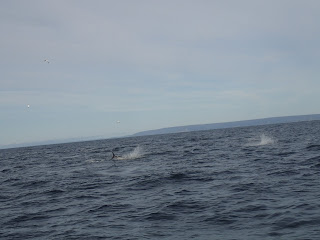
We had fish erupt all around the boat on multiple occasions...imagine twenty 800 lb tuna coming 6 feet out of the water only an arm's length away from the boat. Standing at the back of the boat, you actually got splashed by the jumping fish as they chased billfish (saury) from Cape George to Cape Breton.


Our last bite on Sunday came as the sun was setting...it was our 6th fish of the day...and as I reeled in the Huey bait...WHAM...double header! Double headers happen quite often in fishing, especially tuna fishing and it is quite exciting. However, when both fish are over 700lbs it can be quite difficult to get both fish back to the boat. The captain has to maneuver the boat to make sure the fish don't take all the line off the reel or that the fish cross and cut the lines. Captain Dennis continued to amaze as he flawlessly positioned the boat to ensure both fish were successfully tagged!

Double header


Monday, September 26, 2016

Fall and Herring

Lloyd fights his 9th fish of the day...in a waterspout!!
Capt. Bernie Chisolm passes off another one
TAG is back in Cape Breton to take advantage of one of bluefin tuna's favorite meals...Clupea harengus, aka the Atlantic herring. Herring are a pelagic species which form schools particularly during feeding and spawning periods. In the southern Gulf of St. Lawrence, herring spawn in the spring and fall. Fall spawning occurs mainly from mid-August to October at depths of 5 to 20 m. Eggs are attached to the bottom and large females can produce up to 360,000 eggs. Herring eggs also attract another one of bluefin tuna's favorite meals...Scomber scombrus, aka the Atlantic mackerel. The mackerel are there to eat the herring eggs...and so you have an large amount of prey, which in turn attracts a large amount of predators...from bluefin to pilot whales to seals.

The bluefin are in the Gulf of St. Lawrence to fatten up on herring and mackerel before making their long migration back to the Gulf of Mexico (or Mediterranean) to spawn.

In the first two days back on the water we have had 16 hook-ups!! And so a busy couple of weeks begins...just need some good weather!!

Pilot whales ball up some mackerel

Dr. Steve Wilson tags a bluefin tuna


Wednesday, April 4, 2012

Cachalot app


Here is a short clip we made for Duke University’s Cachalot app, a novel digital textbook designed for students enrolled in Duke’s Marine Megafauna class, but free for everyone, everywhere...check it out at your app store. The video was shot by Robbie Schallert aboard the Bay Queen IV while tagging bluefin off the coast of Cape Breton, Nova Scotia. 

Monday, November 24, 2008

Rick Rosenthal Working with TAG on Tuna Documentary

On Tuesday, Nov. 18, Emmy award-winning cinematographer Rick Rosenthal filmed bluefin and yellowfin tunas in the Monterey Bay Aquarium's spectacular Outer Bay Waters exhibit. Rick is working with Tag A Giant to create a new documentary film about tunas, and our work to understand and protect them. Rick also filmed our team tagging bluefin off the coast of Canada in October, and will continue working with us in the months ahead to gather all the footage he will need to tell our story.

During his career, Rick Rosenthal has filmed some of most challenging wildlife subjects on the planet. His BBC/PBS film Hunters of the Sea Wind was the first major broadcast program to showcase the wildlife of the open ocean. Since then, Rosenthal has filmed over 35 programs, including three award-winning one-hour programs on the great whales, Riddle of the Right Whale, Humpback Whales and Sperm Whales Back From the Abyss, which he shot and produced for the BBC, PBS and the Discovery Channel. He was a principal cameraman for the Blue Planet series and the feature film Deep Blue. His cinematography work on BBC’s current blockbuster series Planet Earth is airing now. Rosenthal’s latest work Superfish, a natural history of billfish, will air on the PBS and BBC networks. Rosenthal has written and published 45 scientific papers, reports and popular articles on marine biology, ecology and animal behavior. He holds advanced degrees from California State University at San Diego and Scripps Institution of Oceanography.