Thursday, October 21, 2010

Maple Leaf Giants

With Fall colors blooming and Celtic Colours Festival in Cape Breton, Canada the TAG team continued efforts to place Pop Up satellite (PAT)  tags in Canadian bluefin tuna in the waters off Port Hood Nova Scotia.


Led by vessels from Gulf of Nova Scotia and PEI fleets the team plied the waters that ranged from calm to high seas for 3 and one half days of fishing.
The Neptuna, Captained by Ross Kues, provided a steady
stream of bluefin along with the other boats.

Eleven tags were deployed on 9 bluefin tuna. Some were nice large fish similar to what the team had tagged in September.
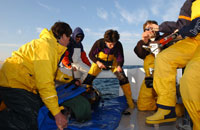
Lip hook master Robbie Schallert comes
face to face with a giant bluefin.

When a tuna is brought on deck, its eyes are covered
and fresh sea water is pumped over its gills to keep it healthy and calm.
Others were surprisingly small- similar to the large class of 8 year old fish that TAG scientists placed 52 archivals in earlier in the year in the waters off North Carolina.  Pop up satellite tags and acoustic tags were deployed and some fish carried a new mini-PAT tag from Wildlife Computers.  Tags will pop up after 210-300 days at sea revealing the mysteries of giant bluefin.
Another giant is measured as it comes on board.

Monday, September 27, 2010

TAG & Tonno Rosso in Italia

Greetings from Porto Barricata! On Thursday, Dr. Pablo Cermeno (WWF) and I arrived in Italy where we were warmly greeted by our gracious host Daniele Crepaldi. Daniele then whisked us to the port for the tournament briefing for the 2nd Edition of the Porto Barricata Fishing Club Tuna Tournament Tag (sic). There were a lot of eager faces and a lot of interest in Tag-A-Giant.

Friday, our first fishing day, was beautiful and over 45 boats fished during day-one of the tournament. Unfortunately, the fishing was slow, but we successfully tagged one 153 cm (60-inch) bluefin tuna that was transferred to us from the "Hook-up," a beautiful 32' Boston Whaler Outrage with twin 275 hp Mercs. Daniele, the tournament organizers, the TAG crew and the fishers alike were all excited about this tag deployment.

Unfortunately, the weather did not cooperate for day-two of the tournament, and Saturday was cancelled.

We were able to fish on Sunday on Daniele's boat the "Kahuna," with five other boats from the port pledging to transfer us any captured fish. The slow fishing persisted and neither we, nor our five collaborating vessels, hooked any tunas.

Not dissuaded, we attempted to fish again today, Monday, but an Adriatic storm brewed up, forcing us to retreat to the port.

Currently, it is very windy, but we are hoping to get out one last day on the water tomorrow before both Pablo and I must leave this beautiful place on Wednesday.

Dr. Andrew Seitz
Professor, University of Alaska, Fairbanks
On location for TAG in Porto Barricata, Italy

Friday, September 24, 2010

Tag A Giant Dreams


TAG has a fantastic weekend in store for anyone who loves bluefin tunas -led by Dr. Steve Wilson and Team Canada- and a Team in the Mediterranean led by Dr. Andy Seitz and Dr. Pablo Cermeno working in the gorgeous Adriatic Sea just south of Venice - now that is hard duty. Of course I am here in my office, looking out at the ocean- writing a grant- can't wait to be tagging tunas again-and have to admit- "wish I was there". If you're a fan of TAG fishing you'll be checking our pages over the next few days. Up in Canada where Dr. Steve Wilson and Mr. Robbie Schallert are making history once again- with the hard working Port Hood Nova Scotia fleet of Tag vessels and our PEI TAG team- led by Bay Queen IV Captain Dennis Cameron, and PEI boats headed up by Captain Bruce Kues and his former record holding father - we're so proud of this team. Today after a post- hurricane Igor patient hold -they went out and together tagged 9 giant bluefin, yes I did say 9 giants- of the 1000 lb variety! Our Canada team off spectacular Cape Breton. A remarkable story unfolded-including fish that measured 302cm- 3 meters plus! We tagged one that big three years ago that swam into the Bay of Campeche in the Gulf of Mexico to spawn. Now anyway you slice it- this is a big fish. They are pushing 1300 lbs at this length imagine a fish over 3 meters in length- on the tag boat and carrying our spectacular Wildlife Computers PAT satellite tag jewelry, thats a smart bluefin (survived a lot of decisions, migrations, humans, and a few white shark/orca encounters I suspsect) - My hats off to our team (I don't wear a hat). But you know what I mean. And to everyone who is a member of the TAG family -just imagine the fun they were having- Rob says he was hand feeding 1000 lb giants behind the boat. I would guess they were trained off NC.

Great job- team Canada! May these fish find the Cabot Straight, See my natal shores of Cape Cod, and visit NC on the way to the Gulf of Mexico Spawning ground- swim free- and swim fast!

Wednesday, September 22, 2010

TAG Team Canada Reports In


The TAG Team in Canada with Dr. Steve Wilson, Dr. Mike Stokesbury and Sir Robbie Schallert had a superstart to our Canadian Campaign in Port Hood, Nova Scotia this past weekend. The team has tagged about a dozen large giants off Port Hood Nova Scotia. The efforts is made possible by the assistance of our great team of fishers from the Region (Captains Dennis Cameron, Bernie Chisholm, Steve Macinnis, Pete Sutherland, Bruce and Ross Kues) and the mates aboard all the vessels but particular Sheldon from the Bay Queen IV. The fish were outfitted with the latest Wildlife Computers MK10 Pop Up Satellite Tags carefully positioned for a journey that might take these instrumented fish to their natal spawning grounds.
Weather was flat calm and the fishing was consistent. As the weather turned the fishing slowed down and now the Tag team is waiting for a weather break having successfully avoided Hurricane IGOR. Go TEAM Tuna!

Thursday, August 19, 2010

The Tuna Research and Conservation Center team from Stanford University and the Monterey Bay Aquarium has just finished an 8-day trip aboard the Shogun in the California Current off Southern California and Baja California. Aboard we had staff from the Tuna Center (TRCC) and Tag-A- Giant Foundation, Ph.D students and undergraduate interns, and a post-doctoral fellow from Stanford University. I have fished with the superb Shogun Crew since 1994, and I don't recall the weather ever being so challenging on a single trip as it was this past week. For almost six straight days we had 15-25 knot winds, and this resulted in choppy seas and a rougher trip than we’re used to at this time of year. Captains Norm Kagawa and Bruce Smith worked hard searching for the bluefin we sought- despite utilizing all the tools of modern science- satellite imagery and even a spotter pilot we were unable during the rough weather period to locate a large school of bluefin tuna we were seeking for collection and tagging. We collect the fish live and transport the fish back to the TRCC for a variety of studies that includes understanding the energetics of bluefin tuna and specific studies focused on how the bluefin can tolerate the cooler waters. These sophisticated studies involve studying the cardiac dynamics (heart rate and beat to beat contraction) of the bluefin’s heart- the Lance Armstrong of the sea. In addition, we’re hoping to start some work on the Gulf Oil spill- where we plan to study how the bluefin tuna is affected by oil and dispersant mixtures. To this end we did collect some Pacific mackerels that will help to also examine some Gulf of Mexico Deepwater Horizon questions. We searched a wide area for the tunas and encountered a wide variety of sea conditions - colder at times (59-64F) than most seasons due to the ocean condition called La Nina- this is when a stronger than normal current south leads to upwelling.

Finally as a new week dawned the weather settled out- and we moved closer to traditional bluefin grounds we fish at this time of year offshore of Ensenada and within 8 hours of San Diego and sure enough we found a huge school of the small fish we were seeking- the good news is we did get some bites and finally put some fish in the wells. The fish were just the size we were looking for and we succeeded at sampling, collection and tagging. To help fill up wells for the collection trip- we stopped off on our way home at Baja Aquafarms- now one of the largest bluefin farms in the world. On a glorious sunny day- made even better by the week of bad weather- the owner and director helped the TRCC reach our scientific goals by allowing us to collect 2-3 year old fish to help complete a full load aboard the Shogun. We tagged some larger fish at the pens with archival tags- which was rather exciting as the fish were without question a bit frisky. This will allow studying the feeding cycles of the bluefin within the pen. The weather was gorgeous, and our day at the Coronados and the farm included some south of the island fishing making it a terrific day all around. We’re headed in to offload the fish- and get back to TRCC where we’ll begin a new year- training fish for our flume and studying the inner workings of Pacific bluefin- thanks again to the Shogun team.

Posted by Dr. Barbara A. Block

Below are some pictures- collecting bluefin and then one of my favorites- Captain Norm with his mackerel stretcher- you can always rely on Norm to keep us laughing.


Friday, May 28, 2010

New TAG study maps bluefin spawning habitat in the Gulf of Mexico

Today in the journal PLoS ONE, TAG scientists Drs. Steve Teo and Barbara Block published a study on habitat selection of bluefin and yellowfin tuna in the Gulf of Mexico. Specifically, this study shows that when bluefin tuna enter the Gulf of Mexico, they are going to specific locations, where cool, productive water in “cyclonic eddies” makes its way along the continental slope. So during April and May, when they are spawning, bluefin tuna are relatively concentrated – whereas yellowfin tuna remain disbursed broadly throughout the Gulf. This suggests that it would be possible to protect the bluefin, which are accidentally caught on longlines intended for yellowfin, by restricting fishing in those specific areas where the bluefin are spawning; but that such restrictions need not reduce yellowfin catch rates since they are more uniformly distributed.

Colors show the expected probability of catching bluefin tuna in the Gulf of Mexico based on fisheries data and tagging studies (red is high probability, blue is low). Illustrates discrete bluefin tuna spawning hotspots in the eastern and western GOM.

This is especially important for bluefin tuna, whose numbers have declined to less than 20% of what they were just a few decades ago. If we can improve management of the “western stock,” which breeds in the Gulf of Mexico (as opposed to the “eastern stock” that breeds in the Mediterranean), this would be a significant step for the population as a whole.

Unfortunately, the implications of the paper also carry a downside for bluefin, in light of the current situation in the Gulf. It appears that one of the key breeding grounds, in the eastern Gulf of Mexico, is currently being impacted by the Deepwater Horizon oil spill. We don’t know what effect this will ultimately have on the spawning tuna or their offspring, but we have been working in the lab on how to measure stress genomically and we hope to move forward applying some of the work to the Gulf of Mexico tuna populations. We are currently collaborating with scientists from other labs in the Gulf region to investigate these questions further.

Visit http://www.tagagiant.org/PLoS_GOM_5.28.10.shtml to learn more about the paper.

Tuesday, May 4, 2010

Hot Tuna and Oil: Bluefin in the Gulf off Mexico

This species, Thunnus thynnus, never gets a break. Imagine a fish with a reproductive strategy where it has to grow from a tiny egg to a 225 lb fish, and than once mature, it goes to spawn in the Gulf of Mexico for 4-6 weeks. If that’s your evolutionary strategy for reproduction, you’d better hope that your spawning ground is just like you left it the year before- warm and clean. The rest of the year the giant bluefin swims the entire North Atlantic ranging from frigid seas off the Maritimes of Canada to Iceland, from the Azores to the shores of North Carolina. Once a year this remarkable fish - ranging in size as a breeder from 200-1400 lbs - comes to the warm waters of the Gulf of Mexico and spawns. I’ve only recently seen bluefin spawn in captivity and they have a remarkable courtship- they swim in a tight school and twirl up a tornado- female just ahead of male, as they move at excessive speeds and then broadcast their gametes into the water.

At a time when our Gulf of Mexico bluefin stock is vitally important to protect, where every last fish that makes it out of the Gulf is vital to the future of this fishery, when it is imperative they spawn without disturbance, an oil spill happens.

Atlantic bluefin tuna are comprised of several populations and the bluefin that gets the largest are from the Gulf of Mexico spawning stock. Over the past three years we’ve been working in Canada to tag the largest fish- to see where the bluefin spawn. From analyzing fish carrying electronic tags we have learned these “Canadian” bluefin go often to the region just north of the Loop current right where the shelf break occurs (see track below). Here on the frontal edge of the Loop Current, the bluefin spawn- leaving their eggs to hatch into larvae. They require warm temperatures and spectacularly clean water. Unfortunately where the oil spill is occurring is essential bluefin spawning habitat. These are places that are the most important in our waters to protect.

Map shows the track from an 8-1/2 foot long Atlantic bluefin tuna tagged off Nova Scotia that swam into the Gulf of Mexico, spent several weeks in the spawning area, then departed (yellow track). The dark blob off Louisiana is the estimated coverage area of the oil spill as of May 3.
Our TAG team spent five years working in the Gulf of Mexico, trying to establish the critical spawning habitat for this species - one of the largest fish in the sea. We saw the seismic boats from several companies out on the shelf break searching with sound for oil. Blasting right where the tuna were spawning. It bothered me back then and I told the head of NOAA about the problem (Dr. Rollie Schmitten). I often wondered if they (the oil companies) had an environmental impact statement that included the bluefin tuna. In these waters not only are bluefin spawning, but many other large pelagics as well- blue marlin, swordfish, and later in the spring, yellowfin tuna. Springtime is a time of renewal in the Gulf of Mexico. This place is the fertile nursery grounds to America’s North American fisheries- so the pain may reach far beyond the shores of Louisiana. For the future of the Atlantic bluefin in North American waters, let’s hope that BP and the Federal government act quickly to shut down the leaks.

-Dr. Barbara Block