Sunday, October 26, 2008

GRANDERS ON THE DECK

TAG team CANADA Continued the remarkable story of big fish with 6 more Canadian Giants tagged and released. The TAG boat and the
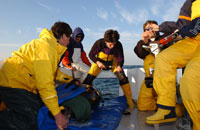
catching fleet worked together transferring 6 fish from the boats to the Bay Queen IV. The team worked together where every boat in the TAG Fleet contributed with a fish for transfer and we succeeded tagging 2.5 Tons of fish several measured in the1000 # class. The Tags are set for 240-300 days- We hope to see where these fish go to Breed. Dr. Steve Wilson and Aaron Spares are leading the charge and the picture above shows Dr. Steve tagging a big one. Aaron, Sheldon (near the hose), mate Mike and Captain Pete are helping on the deck. The fishers of Nova Scotia and PEI are doing the hard work of catching and transferring the fish. More quota has been allocated, when its all captured- we'll be back out tagging- Barb for Dr. Wilson Go Steve!

Saturday, October 25, 2008


Canada Hits 1000!
1,000 TAGS REVEAL MYSTERIES OF GIANT BLUEFIN TUNA

A giant Atlantic bluefin tuna weighing more than half a ton had the honor of being fitted with the 1000th electronic tracking tag placed by our team on an Atlantic bluefin when it was caught and released on Monday (October 20) in the Gulf of St. Lawrence off Port Hood, Nova Scotia. The prized fish, which measured 10 feet in length, was tagged by our scientific team from Stanford University, Dalhousie University and the Monterey Bay Aquarium, working in collaboration with Canadian fishermen from Prince Edward Island and Nova Scotia. The field team was led by Drs. Mike Stokesbury of Dalhousie University and Steve Wilson of Stanford University. Mr. Aaron Spares was also on board helping to tag and lip hook the fish. This is the 5th tag deployed this year from our Canadian squad who also succeeded in the past weeks putting out some acoustic and archival tagged giants. The tunas this week are getting only the Pop Up Satellite Archival tag- build by Wildlife Computers who have been large supporters of the TAG effort.

The TAG team has been tagging bluefin tuna since 1996, when the first tag was put out on a bluefin tuna off North Carolina’s Outer Banks. We have traveled from the Gulf of St. Lawrence to the Gulf of Mexico and from Ireland, to Corsica and to Spain to tag Atlantic bluefin tuna. Placing 1,000 tags on giant bluefin has been a long quest for TAG researchers, whose work has helped to reveal the life histories of these amazing, elusive creatures. The tagging data assembled by the TAG researchers have been vital in identifying how populations of bluefin tuna use the North Atlantic, leading to new discoveries about their physiology, their migratory patterns and their population structure.

I would like to thank all those responsible for helping us to achieve the Herculean task of deploying 1,000 electronic tags on giant Atlantic bluefin tuna, with special recognition of our Gulf of St. Lawrence team who realized the goal: the captains and crew of the F/V Angel Brailyne, F/V Bay Queen IV, F/V Carrie Anne II, F/V Gail O’ Wind, F/V Neptuna, F/V Nicole Brandy, and F/V North Lake Breeze, together with scientists Dr. Michael Stokesbury, Dr. Steven Wilson, Robbie Schallert, Jake Noguiera and Aaron Spares. Special thanks for the support of Dr. John Nielson from Canada’s Department of Fisheries and Oceans. Our gratitude to Captain Dennis Cameron for letting us use his vessel with a super fine door- for tagging. Funding was also from the TAG A Giant Foundation, the Monterey Bay Aquarium Foundation and NOAA. Congrads to our entire team. Go TEAM CANADA!!!

Monday, October 6, 2008

In Search of Canadian Giants

Submitted by scientist Robbie Schallert

The TGF team descended once again on gorgeous Cape Breton Island, Nova Scotia in search for the Giant Bluefin Tuna, and by September 20th five of the TAG boats were on the water. We decided to take advantage of the brief commercial season closure, and it didn’t take long for the first tuna to bite. Unfortunately, we were reminded just how hard tagging Giant tuna can be…after a long fight, with the fish almost to the lip hook, the hook pulled out. For a second, as the tuna hovered at the surface just off the transom, the team scrambled for an over-the-side pop-up tag in a last ditch effort to anoint this beauty with the first tag of the season. In a flash, the fish turned and rushed into the abyss. What a sight to see such a fish…absolutely close to the record! We were concerned about how on Earth we would have gotten it into the boat.


Our spirits still high and the fleet still optimistic, we continued the next morning on the quest for the first Canadian bluefin of 2008. Captain Dennis Cameron and mate Sheldon Gillis aboard the Bay Queen IV guided the TAG boat out of Port Hood, first stopping to jig up live mackerel, and then stopping to pull a small herring net just to make sure we had all our bases covered. After a full day of searching, those two words that make any fisherman’s blood pump…”Hook Up!”…crackled over the radio. North Lake Breeze was hooked into a 300-plus lb fish, and the TAG team scrambled to get the gear ready. The veteran Dr. Mike Stokesbury chose his lip hook and positioned the tuna mat, while making sure the flow of the hose had the proper pressure to ensure the gills would be adequately oxygenated. Dr. Barbara Block checked the tags to make sure they were on and deployable. Once the TAG boat reached the fishing vessel, a delicate handoff of the rod took place. It sounds easy, but with 5 foot seas, a 25 knot wind, and a Giant bluefin on one end, it takes fishing experts to accomplish such an inter-vessel transfer of rod and fish. Sheldon continued the fight, and after a relatively brief battle, the fish was at the leader. To see these guys fight a fish for an hour and then wire the fish effortlessly makes anyone watching feel tired! Dr. Stokesbury had the quickest lip hook to date, and the beautiful bluefin was safely on board. The fish measured over 78 inches, and Dr. Block zoomed into action. This fish got an acoustic, a pop-up, and an archival tag, and the first triple-tagged fish of the season emphatically kicked its tail back into the ocean. While we have not traditionally deployed many acoustic tags, there is a new effort called the Ocean Tracking Network that is establishing acoustic listening stations up and down the East Coast of North America. The acoustic tag on this fish will communicate with the listening stations to let us know its location whenever it is near a station.


The next day brought just as much excitement, as the team again waited with baited breath for its first call to duty. Just like the day before, on a changing tide, the silence was interrupted. This time it was the Angel Brailyne that got her hook in one. A beautiful fish measured at over 90 inches and estimated around 600 lbs because of the girth. You couldn’t have asked for a more picturesque scene…just as the fish was turned loose with its two tags (pop-up and archival), the sun set on the horizon to create one of those magical moments you remember forever.

Third Scientific Technique Confirms That Discrete Western and Eastern Bluefin Tuna Mix on North Atlantic Foraging Grounds

Tag-A-Giant Foundation Scientific Advisor Dr. Barbara Block is co-author on a new paper published in the prestigious journal, Science, entitled, "Natal Homing and Connectivity in Atlantic Bluefin Tuna Populations." The paper was published online on October 2nd and will appear in print later in the month. The study corroborates previous electronic tagging and genetics work conducted by the TAG team and others that there are two unique populations of Atlantic bluefin tuna that do not interbreed but mix on foraging grounds in the North Atlantic. This is the first research to quantify the level of mixing based on feeding area.

The paper analyzes the chemical composition of bluefin tuna otoliths, or earbones, to determine whether individuals were born in the Gulf of Mexico or the Mediterranean Sea, the only known spawning areas of western and eastern Atlantic bluefin tuna, respectively. Otoliths incorporate carbon and oxygen isotopic ratios unique to the waters in which the bluefin swims, creating a birth certificate of sorts.

Otolith samples were collected from bluefin in the Gulf of Mexico, Mid-Atlantic Bight, Gulf of Maine and Gulf of St. Lawrence in the West Atlantic, as well as the Mediterranean Sea. The results reveal a high level of mixing of Gulf of Mexico and Mediterranean Sea-spawned juvenile fish on foraging grounds in the mid-Atlantic. The percentage of Mediterranean fish decreases in the older age classes of larger fish. Interestingly, the research also shows that bluefin in northern New England and Canada are nearly entirely of Gulf of Mexico origin, suggesting that these waters may represent critical foraging habitat of the smaller, more vulnerable population that spawns in the Gulf of Mexico.

Nearly 100% of bluefin sampled on the Gulf of Mexico and Mediterranean Sea spawning grounds were found to have been born in the same area, revealing an extremely high rate of homing that exceeds the fidelity of Pacific salmon to their natal streams. This is not surprising, given previous genetic results that no more than 1 bluefin per generation (~5 years) can transfer to the other population and interbreed to maintain the observed level of genetic difference.

The research has several implications for management of bluefin tuna fisheries and is particularly timely since the international rebuilding plans for Atlantic bluefin tuna will be revisited and likely revised at the ICCAT meeting in Morocco next month. First of all, mixing rates that exceed 50% for juveniles in the Mid-Atlantic Bight confirms that the U.S. fishery is highly subsidized by fish from the eastern Atlantic population. As the eastern population has declined due to egregious levels of authorized and illegal overfishing, the depleted status of the western population has been highlighted as evidenced by the inability of U.S. fishermen to catch our quota. It is clear that current estimates of the eastern and western population size are inaccurate, and only by incorporating realistic rates of mixing in stock assessment models will we be able to reliably assess the populations.

Furthermore, while the overfishing in the Mediterranean Sea is not negatively impacting the Gulf of Mexico population, it is negatively impacting U.S. fisheries and may be largely to blame for the decreased catches in U.S. waters in recent years. This latter point should help the U.S. leverage their voice in management decisions for the Mediterranean fisheries, even if U.S. boats do not fish bluefin in the area.

Lastly, the study has shown that fish in the Gulf of Mexico, Gulf of St. Lawrence and Gulf of Maine are almost entirely from the vulnerable Gulf of Mexico population, highlighting the importance of recovery and protection efforts for bluefin tuna in these regions.

For more information, click here to visit the Tag-A-Giant Foundation page dedicated to the paper.

Tuesday, September 30, 2008

An angler’s perspective on trench warfare

George Shillinger provides an angler’s perspective on tuna tagging research.

I thought that it might be exciting for our readers to provide an angler’s perspective on the fishing and tag deployment experience off Greymouth, New Zealand. I received the following email from angler, Tom Thomson, who is featured within my birthday bluefin blog in this series, regarding our trip on Aug 27-28, 2008.

Christchurch, New Zealand Angler Tom Thomson reports to George Shillinger about his experiences on the Cerveza 2:


Monday, September 22, 2008

Hi George,

Great to hear from you….

We all arrived back very tired on the Thursday night and I found it really tough trying to keep my eyes open for the 3 hour trip back to Christchurch whilst the other drifted in and out of sleep. We had probably one of the most memorable fishing trips we will ever experience and they are still raving about it.

We had some of the fish in a raw state but most of it has been smoked and vacuum packed and it is amazing how many friends you have at times like this. The general impression is that is the best smoked fish we have ever had.

The guys who I brought with me were Craig Tapling, Murray Knight, and Steve Muldoon. In the photo below, Murray is on my left, Craig is beside me and Steve is crouched down beside the fish.


Figure 1: Anglers Murray Knight (left), Tom Thomson (center), Craig Tapling (right), and Steve Muldoon (kneeling) crouch alongside their giant bluefin. (Image: Deckie Redz)

We fished in the order, Craig (broke off after 10 mins when the reel parted company with the rod under the pressure), Murray (about 2.5hrs), Steve (about 2 hrs) and then me(3.25hrs). Murray's was probably the biggest I think and broke off, like Steve's at the leader while trying to get tags in place. We believe that most of them were around the 250kg mark which is fairly average for the area.


Figure 2: A bluefin about to be released from the trace. (Image: Tom Thomson)

Their fight times were around the 2 hour mark but fish were coming in green and full of fight and causing an immense amount of pain to the deckies. I decided to try and tire my fish out a bit more so that we had a better chance of tagging and releasing him, hence the 3.25 fight time.

I've nicknamed mine 'GT' because he was ultra high performance and is derived from our initials (George and Tom). I've assumed that GT survived the next few days as you mentioned the tag would release if he didn't move for 3 days so I guess we now wait for your next birthday and hope the tag pops up and down loads the information as expected.


Figure 3: Heading for home on the Cerveza 2 (Image: Tom Thomson).

Our group is loosely associated through our jobs and this trip was the culmination of a year's planning. We have all been game fishing before but agreed that this is unlike anything we have seen or experienced and is a once in a lifetime adventure for most of us. Craig and Steve came down from Auckland and Murray and I are from Christchurch.

What other information would you like?

I'm interested in any information you may have on GT and his(her?) exploits.

Kind regards

Tom

Tuesday, September 23, 2008

Third Week Tagging Giant Pacific Bluefin in New Zealand

Latest news from the New Zealand tagging team. Entry submitted by Tim Sippel.

After two intensive weeks of fishing, the 2008 bluefin tuna satellite tagging program had made good strides towards the goal of deploying 25 pop-up satellite tags. Although New Zealand’s winter weather hasn’t been great this season, we’ve managed to tag 21 bluefin by the end of August.

The first week of September brought a spate of unpredictable weather, making it difficult for several days to figure out when to go out again. On September 4 the call was made to go out for another charter with Captain Chinner, and crew Josh, Bryce and Andrew aboard Cerveza II. The west coat of New Zealand is dotted with numerous fishing ports that require crossing over submerged sandbars. Greymouth is one these ports, and its bar can be troublesome for even the most seasoned and confident skippers. On this trip, Chinner’s unrivalled experience and iron clad confidence navigated us through a gauntlet of white capped waves that would have chased many other skippers back to the docks.

Figure 1. Cerveza II leaving for a bluefin trip from Greymouth’s harbour greeted by ocean waves across the local sandbar. Photo: Pete Idoine


With those obstacles behind us we motored for the hoki trawlers, about 35 miles offshore. However, the unpredictable weather was worsening, and not improving as forecasted. By nightfall winds were up to 35-40 knots and conditions weren’t fishable, so we hunkered down and stopped fishing for several hours to let conditions ease down again. When things settled back down we moved back to the hoki trawlers and put lines in the water. After a few hours we hooked up, and the fishers who chartered the boat got the one they wanted for ‘kai’ (Maori term for food) to share with family and friends upon returning to port. One +200kg plus bluefin provides a lot of kai for a lot of people, so the next was to be satellite tagged. In the early morning of 5 September we hooked up to a bluefin to be satellite tagged. With a chop still on the water, deckies Josh and Bryce got the fish to the stern. However, the leader clipped the boats trim tabs in the process, and was frayed and weakened as a result. Within mere seconds of tagging this fish, the weakened leader broke and with a swift kick the bluefin disappeared. After being battered for much of the last day on the water, it was particularly disappointing to loose this fish, but that is the nature of this work.

After putting in a few more hours of unsuccessfully trying to hook another, it was time to head back. As we headed in the weather finally eased back and the trip back was swift in the calmed seas. Thankfully, the charter Oracle was headed out for a new charter at the same time we were returning. Oracle’s skipper Mike Boswell generously agreed to let me ‘tag along’ on his trip too.

Oracle takes a different approach to bluefin fishing by using only stand-up gear instead of the more commonly used fight chair in New Zealand’s big game fisheries. Oracle arrived at the hoki trawler ‘Rehu’ in early evening and lucky angler Peter Idoine was the first to hook up soon after his line was wetted. Pete had never been big game fishing before (although had caught some yellow tailed kingfish previously). Learning to gamefish for the first time by using stand up gear on giant bluefin is akin to introducing someone to the rodeo by strapping him straight into the saddle with a bronco. Pete proved to be a natural and showed great poise in bringing his fish to the boat in just over 2 hours though.

Figure 2. Pete Idoine battling his first bluefin, with Tim holding onto the back of his belt for good measure, and deckie Aaron looking on in the background. Photo: Pete Idoine


With Pete’s fish landed it was time to chase another for tagging. As the clock stroked 11pm on the night of 5 September, line began screaming off of the reel again as we’d hooked another bluefin. We had no clue what was in store for us with this fish though. When using stand up gear on bluefin, it is not uncommon for the fish to outlast more than one angler, requiring the rod to be passed to fresh legged fishers. However, it is less common for one fish to outlast 8 anglers and wreck at least 4 different gimble belts over a 12 hour period! It was as if the beast hooked on the end of this line was Michael Phelps embodied as a tuna if you considered each of the 8 anglers he beat a gold medal in the gamefishing Olympics!

Anglers Peter, Grant, Peter, Yab, George, and Tom lined up to take turns battling this fish. When passing the rod from one angler to another, it took all hands on deck to unseat the bent rod from one anglers gimble belt and reset back into the next angler's gimble belt.

Figure 3. Four people struggling to unseat the rod from the anglers gimble belt so it can be passed onto the waiting angler behind while the bluefin continues his unrelenting battle. Photo: Pete Idoine


Around 5am I went for a nap as there were no signs of this fish surfacing soon. I awoke around 7am to fresh sunshine and angler number 5 online with this same fish and no indication that it was anywhere near as tired as the 4 other guys who had taken turns online with it. Eventually angler 5 relented to angler number six who eventually relented to anglers seven and eight, who were actually two guys who’d already been online with it in the previous night. Finally as the clock passed 11am this bluefin surfaced and George (man number eight) dug deep down to get it to the stern. And then as suddenly as this fish was initially hooked, it just as suddenly flicked it tail, catching the line on the boat’s hand rail and snapped the line. After more than 12 hours this bluefin was gone in less than a second!!! An exhausted disbelief fell upon everyone aboard, and the decision was made for everyone to get some sleep. Everyone was spent, and we needed to recoup for a second night of fishing.

We awoke in the late afternoon and chugged back to the hoki trawlers for another go at luring a bluefin online with a yummy piece of defrosted hoki. Although I was on the boat to tag fish and was not anticipating catching one, the anglers wryly told me I’d have to share the pain in catching the next fish if I could have a chance to tag it. I agreed as I was there to tag and was the only non-crew member there who hadn’t been online with the 12 hour beast. After dark we hooked up our 3rd fish which was initially fought by two anglers who were still weary from the 12 hour battle. Angler 3 was me, so the gang converged to help pass the rod over. The heat was on both literally and figuratively as I could feel my thighs burning and I had been at sea for roughly 50 hours without tagging a bluefin yet. Thankfully, this fish capitulated to the stern in 45 minutes, but to my dismay the decision was made to keep it instead of tag it. Nevertheless, I am grateful to the anglers for allowing me to join them on the trip they had chartered. It was a privilege to experience a giant bluefin on stand up gear. Everyone, including the anglers as well as captain and crew of the Oracle are first rate!

Figure 4. Tim hooked up with Tom anchoring the back of the gimble belt. Photo: Pete Idoine

Oracle’s mission was complete, but yet again as one charter completed, another was about to begin. Chinner happily agreed to take me along on his next charter again, so I immediately joined them for another try to tag bluefin with one of the four tags remaining to be deployed.

Reuniting with Cerveza II was welcome under the settled and more favourable weather than the last trip. The charter on Cerveza this time was a group of farmers from outside of Christchurch who’d come to experience bluefin fishing and likewise bring a bit of kai home. I explained what the project was about, showed them some satellite tags, and explained the value of this research. Once they’d landed a fish to bring home, they were happy to allow any others to be tagged for this research. Cerveza II and numerous other boats in this fishery have a policy of no more than one bluefin landed per charter to ensure they are also contributing to the equally rewarding pursuit of tag-and-release fishing. By the early morning of 7 September we hooked up to another bluefin. After a relatively short 30 minute time this bluefin was calmly lead to the stern by wiremen Josh and Andrew and after more than 65 hours at sea this time out, the 22nd bluefin of the project was satellite tagged. At an estimated 250kg, it was quickly tagged and upon release it swam away with a calm flick of its tail. At 4:50am, a few hours after releasing that fish another was hooked. It was a livelier bluefin than the last and it was online for 50 minutes before Josh and Andrew brought it to the stern. They positioned it perfectly for a solid tag shot. And with that, this bluefin estimated to be 220kg became the 23rd bluefin satellite tagged in the 2008 project.

As often happened in 2008, the bite turned off at dawn and within a few hours Cerveza II turned for home. This leg of the project was quite eventful and challenging. But with 23 bluefin tagged, the bluefin team at Stanford, Blue Water Marine Research and Auckland University are quite happy with the achievements of 2008. Two satellite tags remain with Chinner who might have an opportunity to tag this week on his final charter of the season. Chinner has seen and done it all before and we’ll be grateful if he can put these last two out. But if not…well we wait with ‘baited’ breath for the data from these other 23.

We also heard from the crew of one of the commercial hoki trawlers that they could see several satellite tagged and conventionally tagged bluefin swimming under their boat, feeding on hoki scraps as the nets were hauled aboard. Great news to give us another shot of confidence that things are going well!

Monday, September 22, 2008

Birthday Bluefin – August 27, 2008

George Shillinger reports from New Zealand on a birthday outing with the Cerveza 2

Following four back-to back runs on three different vessels, I was craving some rest but anxious to finish the tagging work with our team in Greymouth. I had already extended my trip and could not afford to stay any longer.

Figure 1: The docks at Greymouth (Image: George Shillinger)


I was slated to present at the Biologging 3 Conference in Pacific Grove, CA on September 2, 2008 and had to return the US to prepare my talk.

Figure 2: Biologging 3 Conference Logo (Logo by Kate Spencer)


With good weather still on the horizon, Captain Larry announced that we would be making another quick turnaround in Greymouth. Unfortunately, time was too tight for a dinner reunion with the 4Gs. We had plans to depart the following morning with a group of anglers from Auckland who were eager to assist with the tagging effort. I hurried back to the hotel to organize my gear for tomorrow’s deployment.

Figure 3: Revington’s Hotel – our home base in Greymouth (Image: George Shillinger).


Figure 4: Tim Sippel (left) and George Shillinger (right) work in the “office” at Revington’s Hotel (Image: John Holdsworth).


Figure 5: The Jade CafĂ© in downtown Greymouth – a breakfast venue for the tagging team when we are not on the water (Image: George Shillinger).


Fortunately, I was able to make a quick morning visit to the dental office of Dr. Garry Rae. It was my birthday in New Zealand (August 27), and Dr. Rae had kindly promised to repair a crown that I lost while chewing candy on my first Cerveza 2 charter (see blog #1) of the tagging season. Thank you, Garry, for the excellent birthday gift!

Figure 6: George and Dr. Garry Rae at Dr. Rae’s dental practice in Greymouth.


Larry arrived at the docks with positive news from several boats about recent catches of large tuna in the Trench. Although weather reports advised otherwise, the winds had resumed and the weather appeared to be taking a turn for the worse as we headed out over the Bar.

Figure 7: View from the boat while crossing the bar (Image: George Shillinger).


The skies darkened and the winds increased to 20-25 kts as we raced towards the grounds. The sea had turned into a rollicking mass of whitecaps and spray, making for an exceptionally bumpy ride. A few of the passengers hunkered down to absorb the buffeting, laying prone on the cabin floor, while the crew focused on prepping tackle and bait, peeling spuds, and keeping cooking gear from launching across the cabin.

Figure 8: Vessels Cascade (left foreground) and Cova Rose (right foreground) wait with Cerveza 2 for the Vessel Rehua (left background) to pull its hoki bag (Image: George Shillinger).


The first trawler that we encountered upon arriving at the fishing grounds was the NZ trawler, Rehua. Sportfishing vessels, Cova Rova and Cascade joined us, rolling in the swells while we waited for Rehua to pull the bag.

Figure 9: Vessel Cascade in the trough (Image: George Shillinger)


With the bag ascending, Captain Larry positioned the Cerveza alongside the trawler, while Deckies Redz and Josh prepped a hoki bait. Angler Tom Thomson, anxiously manned the chair as the Auckland anglers prepared for battle.

Figure 10: Seals and birds feast on scraps from the hoki bag. (Image: George Shillinger)


Over the course of the next 15 hours, we battled strong winds (20-25 kts), a rising swell (to 3m), and three giant tuna. The bite never slackened, but sadly all three fish were lost (2 broke off at the trace and another when the line snapped) before any tags could be deployed.

We finally deployed our first tag of the trip when angler Tom Thomson succeeded in bringing an estimated 225 kg fish to the boat, after a 3+ hour battle that began in the pre-dawn at 3:55 a.m. Although we captured fleeting glimpses of the trace on several occasions throughout Tom’s fight, the fish repeatedly turned tail at the rail, disappearing into the darkness every time capture appeared imminent. Deckie Redz wired the fish and made good on his promise to present me with a “Birthday Bluefin.”

Figure 11: Sportfishing vessels gather around the NZ Vessel Amaltal Enterprise as she pulls in a loaded bag of hoki. (Image: George Shillinger)


Figure 12: After three lost fish and one tag deployed, Tom Thomson (left), George Shillinger (center) and Tom’s team of anglers take a bluefin home for dinner. (Image: Deckie Redz).


With the first tag of the trip finally deployed, the anglers collectively decided that it was time to take a fish. Three hours later we were on our way home with an estimated 230kg tuna headed for the icebox. Meanwhile, I took advantage of the opportunity to investigate the tuna’s gut contents (filled with hoki bones – no surprise!) and collect tissue and DNA samples.

Figure 13: Hoki bones in the stomach of a giant Pacific (Nothern) bluefin (Image: George Shillinger).


As we headed back towards Greymouth, the crew surprised me with a ice cream birthday cake --- apparently a Kiwi speciality (for kids) --- that generated congratulations and fond memories from all aboard!

Figure 14: Kiwi Style birthday – an ice cream cake from the crew of Cerveza 2 for George Shillinger! (Image: Josh Worthington)