Wednesday, November 7, 2007

First Data From Canada!

The first pop-up satellite archival tag (PAT) deployed last month in Nova Scotia popped up right on schedule and we now have data giving us a preliminary glimpse into the behavior of giant bluefin tuna up in those cold northern waters. This tag was programmed to release from the fish after only three days, and the fish was tagged with a longer-term PAT as well. These tags are primarily used as survivorship tags to garner information on where the tagged fish have moved to post-handling at the vessel during tag and release operations.

As you can see from this map, this fish which we measured to be 272 cm in length (translating to 339 kg or 747 lbs in weight) moved a little way north up the Cape Breton coast in the three days between when we tagged it and when the tag popped up. We’re eager to see where it will move to by the time the longer-term tag we also attached to it pops up!

In addition to giving us a highly accurate measurement of the location where the tag popped off, the PAT tag transmits to satellites data on the depths and temperatures that the fish occupied, which tell us a great deal about the behavior of the fish. In the graph below you can see the temperatures and depths the fish experienced over the course of the three day deployment. The y-axis (i.e., the vertical axis) on the graph shows depth, while the x-axis (horizontal) indicates date. Water temperature is then shown via the color scale, with red temperatures indicating warmer waters and blue indicating colder. What you can see is that there is a region in the water column from the surface to about 30 m in depth where water temperatures are relatively constant at around 13C because the water in this layer is well-mixed. Below this mixed layer is a region referred to as the thermocline where temperatures drop rapidly. You can also see that the depth of the thermocline became slightly shallower over the course of the three days as the fish swam northwards.

This next graph shows the proportion of time during which the fish was in waters of particular temperatures. You can see that it spent most of its time in the 12-14 degree waters of this mixed layer and only spent a small proportion of each day in the colder and deeper waters of the thermocline. We think what it's doing is hanging out in the warmer waters of the mixed layer that it finds more comfortable, making only brief forays into the colder waters below to feed on the prey that must be found there. As we get more data back from the longer-term tag attached to this fish, and from the other fish tagged in these Nova Scotian waters, well learn much more about how the fish behave in this cold water region.

Friday, October 26, 2007

Oh Canada! Thanks for Getting the Giant Bluefin Tagged


Canadian tagging continued in the past two days with super fall weather, calm seas and more success tagging giant bluefin. The Canadian fleet of "TAG" vessels working off Port Hood with Dalhousie Scientists, Dr. Mike Stokebury and Aaron Spares continued tagging with Captain Dennis Cameron and mate Sheldon Gillis of Port Hood, along with vessels specifically working for the TAG team from PEI and New Brunswick. In the past two days 4 more giants were captured brought on board the designated surgery vessel measured, and released successfully with Wildlife Computers Pop up satellite archival tags. The largest fish in the past few days was a butterball of a bluefin- measuring 292 cm CFl and had a half girth of 111 cm. That is one fat fish. The TAG A Giant team has completed the mission- and together we've tagged 15 Giants and 4 have double tags (second short term pop up or an archival). We're very enthusiastic about this effort and look forward to reporting the results.

The Cooperation of the local vessels in the region has been fantastic. Everyone mastered catching, transferring and releasing fish "TAG style" quickly. We have made new friends in this spectacular Cape Breton region and the memories will last a long time. The long term pop up satellite tags are set for 240, 270 and 300 days- and hopefully they will remain on the fish. The major objective is to learn when and if these giants are moving into the Gulf of Mexico for breeding. The tagging effort will be augmented with genetic efforts to identify these fish.

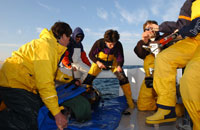
The pictures here show Dr. Mike Stokesbury working with a giant tuna, Bruce Kues of PEI catching a giant- and Steve McGinnis- who captured the last fish today- for the tag team.

Thanks to everyone in the region for making the TAG effort for bluefin successful! These are the largest Giants ever tagged anywhere on the Globe- Thank you Canada.
Yours truly, Dr. Barbara Block, Stanford University

Wednesday, October 24, 2007

All Canada Team Tags 4 More Giants


We're pleased to report our all Canada TAG team led by Dr. Mike Stokesbury today

tagged 4 more giant bluefin with a small fleet of TAG boats from Nova Scotia and PEI. The team reports the fish were in the 800 to 900# class. While I am back in my laboratory at Stanford- I am still thinking about the fishing and the giants. It was an awesome place- and considering we were only there a week- its an amazing story to be able to tag such large giant bluefin. Cape Breton was spectacular as a venue and our TAG Surgery vessel Captain Mr. Dennis Cammeron and mate Sheldon Gillis were remarkable people. Our techniques that we've been using- work well- the lip hooks are specially designed titanium hooks that the folks who've done this the most (Andre and Mike) put in the fish at the edge of the lower jaw. We than use as many folks as necessary to pull the fish on the boat- the use of the vinyl slippery mat makes the fish- easy up relatively easy. We irrigate the bluefin on deck- and we see them absolutely enjoy the flow of seawater sucking oxygen as we tag them- you can watch as the opercle flaps

actually move. Than we place the tag in the dorsal side- or sew in an archival- and within 3' we're spinning hte fish around with the mat- and shooting the fish out the door. They kick hard as they say good bye to the

tag team. Currently all the fish are in the 275 to 305 cm class (curved length). The tags all carry a mortality program and thus far we're pleased to say- all systems are go- these fish are surviving just fine. The first fish carried a double mortality tag program- two tags to be sure on survivorship- one short term that popped up and showed the fish making regular dives just after release from the surface to about 50 m depth. This fish's tag popped up some 27 nm from the tagging location and headed to the north.

I've put up a photo of last weeks operations- hopefully with some good weather the TAG team will get all the allocated tags in the ocean and we'll get a better handle on foraging behavior, migrations and spawning location for these Canadian giants.

Friday, October 19, 2007

5 more giants tagged in Canada!

The TAG team was back on the water today and tagged five more giant bluefin. All were in the 900-1,100 pound range. For the first time in TAG history, one of the tagged fish was so big that the trusted 300 cm measuring tape was not long enough to measure it. We'll post photos when the team is back in the lab.

Thursday, October 18, 2007

Tag-A-Giant in Canada!

Drs. Barbara Block and Andre Boustany are currently up in the small fishing community of Port Hood on Cape Breton Island in Nova Scotia, Canada. The bluefin fishery there targets fish in the Gulf of St. Lawrence, and is known for the very large size of fish that visit those cold northern waters in late summer and early fall. Barbara and Andre are heading up a team that is trying to tag some of those big fish.

Today was their first day on the water, and they caught three fish. One was lost, but they tagged the other two, one of which was 273 cm long and estimated to be 1000 lbs in weight! The weather looks good for tomorrow, and hopefully they'll be successful again.

Monday, September 17, 2007

Tagging Giants Down Under - #6 - 5 more Giants!


TAG scientist George Shillinger is back from his incredibly successful tagging expedition in New Zealand and is ready to share his adventures. Below is the sixth entry in his seven-part series .

After our extremely successful 24 hour tagging trip, we headed to Westport to drop off the 4Gs and pick up the two passengers for the next charter – father and son team of Owen and Trevor Hart.

By mid-afternoon, we were underway again --- heading South following reports of giant tuna occurring en route to Greymouth. The weather had taken a tuna for the worse and another low pressure front had closed in on the South Island. Heavy rains poured down upon us as we raced through increasing winds and swells to the fishing grounds. Shortly before midnight, about 40 miles south of Westport, Captain Larry picked up some marks on the sonar that suggested bluefin were in the vicinity.

Without a trawler nearby to draw the fish to the surface, we began chunking hoki bait in an attempt to bring the tuna to our boat.

Within seconds we had a fish on – but after a gallant fight in the driving rain, the fish was lost at the leader when the hook pulled out. This was the first fish that we’d lost on the trip – and it was followed in quick succession by another giant tuna that snapped the leader as it approached the rail.

We tagged our first fish (~ 260 kg) of the second charter after a 65 min battle at 1:40 a.m. Adrain wired the fish beautifully (caught by Trevor) and it came up alongside the boat for a perfect tag strike. The father and son team fished non-stop for the next 10 hours --- catching and releasing three more tuna, including a huge fish that Captain Larry estimated to weigh over 350 kg!

Our final fish was a 300+ kg beauty that was caught by Captain Larry in 30 minutes on a hand line (tossed on the starboard side of a hoki trawler that was swarming with big fish) with a hoki-baited circle hook.

Tagging Giants Down Under - #5 - 400+ kg!


TAG scientist George Shillinger is back from his incredibly successful tagging expedition in New Zealand and is ready to share his adventures. Below is the fifth entry in his seven-part series.

Within less than twelve hours, the Greymouth Gourmet Guzzlers Group (4Gs) had caught and released four giant tuna. After exchanging salutations with a Kiwi observer standing on the deck of a Russian trawler, we were alerted to the nearby presence of a school of giant tuna.

The tuna were gathered in numbers at the trawler’s stern. They moved wraithlike through the water in pursuit of detritus and waste that spilled from the ship’s onboard fish processing plant. Our jaws dropped in awe, as we watched one tuna after another rising to the surface, flashing momentarily, and then disappearing in unison under the passing swells.

Adrian and Josh worked quickly to rig a giant hoki bait and Captain Larry found position alongside the trawler, aiming the Cerveza 2 so that she would pass within meters of the cod end of the bag. The bait hit the water, swung past the trawler’s stern, and fell into our boat wake. Within seconds the bouncing hoki was slammed by a monster tuna.

But it was a short bite --- the tuna spit the hook, and left us with jaws agape. In frustration (and anticipation, we raced back to the trawler to throw another hoki into the water. Within seconds another giant tuna slammed the bait – fish on! Line screamed off the reel and the pole bent nearly double as the fish took off on a scorching run!

Nearly 2.5 hours later, at approximately 12:17 p.m. a.m. on August 18, 2007, Mike Trousleau “landed” into the biggest tuna that Captain Larry Johnson and his crew had ever seen. As the fish came to the rail, the anglers, captain, and crew were confronted with the decision to either “land and carry” or “tag and release” a potential world record fish. The decision was simple and unanimous. We were not about to miss the opportunity to tag this beautiful bluefin!

Wireman, Adrian Stokes, masterfully restrained the giant fish alongside the boat and lined it up perfectly for me to make the tag stick. I aimed the dart for a spot just in front (2”) and below (3”) the leading edge of the tuna’s second dorsal fin and moved quickly to avoid crossing paths with Adrian and the mighty fish.

With the tag safely deployed, deckie Josh Worthington bravely leaned over the rail to capture a DNA sample. As Adrain clung to the wire, Josh grasped the tuna’s right pectoral fin with his left hand and successfully clipped the fin. We had a sample for the biggest New Zealand bluefin on record!

We released the big bluefin seconds later and watched it drift back for a moment behind the boat, before turning and righting itself with several strong tail thrusts – diving into the depths with the tag in tow.

Although excitement was in the air, it seemed that the bluefin fared better from the battle than fisherman, Mike Trusleau. That said, we established that Mike was a legend for this display of fishing prowess but, more importantly, we were thankful to Mike and his friends from the 4Gs for their commitment to “catch-tag-release!”