Wednesday, July 16, 2008

Tagging Pacific Bluefin


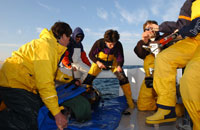
Epic- Remarkable- Inspiring- Those are words to describe today, Friday, July 11th aboard the F/V Shogun. I’ve not experienced a day fishing and tagging Pacific bluefin like this since early August of 2002- same place, same ocean- but a long time has passed since the bluefin were biting like this. It is a day you live for as an angler- and as a tuna scientist- the fun of such great action keeps you enthusiastic about what we’re doing forever. Bluefin decided to feed today, after they had stayed off the bite on Thursday, and with this-along with some spectacular weather, what had been a trickle of tagging for the first half of our trip- turned into wide open fishing-tagging and releasing effort, as fast as our teams could go. We first loaded up our live wells with 7 additional bluefin for transport back to the Tuna Center- and put a surgery station open sign up on our archival implantable tagging station. Captains Norm & Bruce along with mates Tommy, Patrick, Matt and Randy (our chef) were the anglers who specialize on these long range trips- getting the fish in fast- which helps to guarantee survivorship post surgery & release. The fish were coming into the slings at the swim step where the action for Ty Brandt, Luis Rodriguez, and Alex Norton was as fast and furious as it gets. We spent the morning tagging small bluefin that ranged from 12-20 lbs with the occasional 40-55 lb fish in the mix- they were all lifted aboard the Shogun in a sling of water, measured, tagged and released. When the fishing is this good the scientists (~10 of us) from our team have to remain at our stations to keep up with the line up of fish waiting to receive implantable archival tags. Two green conventional tags near the base of the second dorsal fin- provide anglers and commercial fishers with the advance notice that inside the fish is an archival tag that garners a big $$ reward when returned. A long green Teflon sensor stalk protrudes through a small incision out of the fish- collecting valuable data tracking their movements in some cases tracking individual bluefin tuna as they migrate back and forth across the Pacific 20,000 nm. At one point today-the bluefin were hanging in slings, 3 and 4 deep waiting for surgery but with the steady morning action we trained Mr. Jake Noguiera, TRCC technician, and avid fly fishermen and fly tier who along with long time MBA aquarium veteran Mr. Chuck Farwell led a second station which eased the pressure on Robbie Schallert and myself. At one point every 2 to 3 we had a new tuna in the surgery stretcher- it was continuous for the entire day, with Steve, Nishad, and Dane lifting every fish to the station and Stanford University students, Gen Del Ray and Christine O'Neil along with Dan Madigan kept the surgery stations organized. When we were done- 88 Pacific bluefin were tagged, 6 live ones swam in the wells, another half-dozen samples for a Ph.D students project measuring the genomic and protein expression of bluefin had been landed. 100 bluefin caught aboard the Shogun in a single day- Glad we’re able to say that these fish are here- that they’re biting sardines- and look plentiful at the surface with great action- boilers, jumpers and foamers. Whales, albatross, dolphins and bluefin- what a show.

Thursday, July 10, 2008

Unloading at Fisherman's Landing


We came in with our full load of bluefin, but unlike years past where we usually unload at Scripps dock, we came right in to Fisherman's Landing. Here Norm pulled the Shogun in as close as he could, and we unloaded each fish individually from the well in a sling of water. The hard part was that we had to walk, and run the fish- 400 feet up a ramp- across the dock- and down a sidewalk to get to the Tunabago truck, that has been built specifically for transporting fish. The driver of the truck had done a masterful job of pulling it into the crowded Fisherman's Landing parking lot, and Joe Welch and Ryan from the Monterey Bay Aquarium met every fish- and unloaded them into some cold Monterey ocean water within the truck. The fish lit up immediately and were looking super after their relatively short 12h transport from the ocean. These bluefin circled beautifully in the tank, and the entire load was transported aboard a big rig truck, 8h over land, through LA and up the Interstate to Monterey where they were unloaded successfully into the Tuna Research and Conservation Center tank. All 14 fish in the load (about 12-18 lbs each) survived and were reported to look very good in their new home. Two fish from our prior year's collection are in the tank and will help the new fish learn to feed. We hope later in August to implant heart rate tags in the fish and conduct some research studies on bluefin- the olympians of the sea. We headed back out aboard the Shogun and fished for the latter part of the afternoon-Pilot whales, Risso dolphins greeted us. Hopefully tomorrow we'll find some more fish.

Wednesday, July 9, 2008

Pacific Bluefin Tagged!

The Tag-A-Giant team is currently onboard the F/V Shogun for our annual tagging and collecting trip. After two days in U.S. waters, we're now fishing in Mexican waters where a very nice showing of tunas occurred. Small bluefin were feeding at the surface in numerous spots. Some are the smallest fish we've seen in years- measuring 63-68 cm- about 5kg fish. We were able to collect 16, tag about 10, and then collect 3 for sampling by Ph.D students doing projects on physiology and ecology. It's been a team effort - we're after bluefin from the 2nd year class - fish that are new arrivals from the western Pacific. Catching them can be challenging. We were able to switch to lighter tackle, and sure enough we hooked over two dozen on light tackle.

Bluefin Blitz!


We've had an exciting day aboard the Shogun. We've been in an area that has some very spectacular schools of small bluefin- exactly what we're looking for. Today was an Audubon special with whales, albatross, jumping bluefin- and albacore- sometimes all around the boat. The bluefin are two year old bluefin- about 15-18 lb fish- perfect for collecting- and placing in wells flowing with seawater below the deck. The bluefin made some spectacular shows- at the surface- aggressively feeding, jumping and exciting all of us. We have not seen such intense surface action in two years. Sure enough we slid in on the fish, and both crew and scientists hooked up with live sardines. Our first priority was to fill the wells so that we could transport the bluefin back to Monterey for our Tuna Research and Conservation Center program. There the bluefin will be put through a variety of programs including having a new heart rate tag implanted inside the body cavity. Eventually some might make it to the "show," the Monterey Bay Aquarium's Outer Bay Waters tank where today, bluefin as large as 500 lbs collected 8 years ago by the Shogun are swimming gracefully. Once we collected fish and filled the wells- the archival tagging began. We were able to get out about 8 tags, a great start, all programmed to take high resolution data- at 4 second intervals. Imagine this- every 4 seconds we get ambient light, temperature, pressure and internal body temperature. The data allows us to "see" what a bluefin does from the second he or she leaves the boat. We're hoping the tagged fish will remain in the Ocean for years- with the tag capable of over 5 years or more of data logging. To date, our research team has collected over 50,000 days of Pacific bluefin tuna data with our archival tags, and our research will provide scientists and fisheries managers the basic information required to build models of how the bluefin use the California Current waters. It has been a super day- with inspiring shows from juvenile bluefin- and a scattered albacore bite mixed in later in the day. We're headed in to San Diego with the load of fish, and our team could not be happier.

Monday, July 7, 2008

TGF Team Onboard F/V Shogun


Our annual tuna tagging and collecting trip has begun aboard the F/V Shogun with Captains Norm & Bruce. We left San Diego on a hot and sunny Saturday afternoon, loaded up with live bait, electronic tags, and sampling gear to study tunas for the next 9 days. Our objectives are to collect small bluefin to bring back to our lab- and to continue the archival tagging of live fish with implantable tags. Our trip is part of the Tagging of Pacific Pelagics program (www.topp.org). Together the tuna team at TOPP has deployed over 1000 electronic tags in Pacific bluefin, yellowfin and albacore tunas. The team has focused implanting tags in Pacific bluefin, with over 430 thus far. In addition we've put in over 239 tags in albacore tuna. Our first day out we headed toward San Clemente Island where there had been a sighting of bluefin tuna in the past week. The sea surface temperature charts looked interesting to the south of the island, and we worked a frontal area from the 43 bank up toward the island. Water temperatures were in the range one would expect for bluefin. We were greeted by fin whales and blue whales, as well as schools of bonitos. Our Ph.D students, Dan and Nishad, sampled the bonitos to compare their physiology and ecology with tunas as we continued looking for bluefin to collect or tag. Sure enough on the first day late in the afternoon, Mr. Chuck Farwell sighted some jumpers that turned out to be the one show of bluefin all day. The fish went down and sunk out of sight when we approached the school, but our spirits were high having seen the right size for collecting so quickly. Seas were calm, food was terrific and the entire team looked forward to having a bite. Word of bluefin to the south of us was solid- so we're hoping to head in that direction in the coming days.

Thursday, July 3, 2008

TGF @ Atlantic Bluefin Tuna Stock Assessment

The 2008 Atlantic bluefin tuna stock assessment session concludes its business tomorrow in Madrid, Spain. The Tag-A-Giant Foundation was represented at the meeting by Dr. Andre Boustany, a post-doctoral research associate at Duke University. He presented a paper to the scientific body on the preliminary results of TGF's October 2007 tagging campaign in the Gulf of St. Lawrence, Canada. For pop-ups to date, three of the six tags that remained on fish beyond the onset of the breeding season have popped up in the Gulf of Mexico and three in the western North Atlantic. The tagging data support the hypothesis that strong linkages exist between the Gulf of St. Lawrence fish, the North Carolina foraging grounds and the Gulf of Mexico spawning grounds. To date, none of the fish has a geoposition in the eastern Atlantic management unit (east of 45W longitude). Six additional tags are due to pop-up in the near future.

Drs. Nathan Taylor and Murdoch McAllister from the University of British Columbia presented a new stock assessment model developed with the support of TGF that incorporates cross-over rates of the eastern and western stocks estimated from electronic tagging and chemical analyses of bluefin earbones, or otoliths. By better accounting for the significant percentage of fish from the eastern population that are taken in West Atlantic fisheries, the new model should lead to a better estimate of the number of bluefin tuna from both stocks remaining in the Atlantic Ocean.

The 2008 stock assessment results will be finalized and released in September.

Saturday, March 15, 2008

Archival Tagged Bluefin Recaptured in the Gulf of Mexico


The lab was a buzz with the news that an Atlantic bluefin tuna released in January of 2004 from North Carolina and implanted with an archival tag, was recaptured by a US longliner operating in the Gulf of Mexico. We look forward to receiving the tag the first ever returned in US waters on the spawning ground. We've been able for years to piece together the tracks of bluefin who move into the Gulf to breed from North Carolina, and New England releases, and from release of Pop up satellite tags from Gulf fish, but never have we obtained an archival tag- that is from the recent generation of our archival program- with this much promise. One Caveat, is this tuna is carrying an archival tag of the A-series in our long Development history of electronic tags- if only it had been D-series, I'd be super excited. The tags with an A have had a battery issue where after 700-800 days at sea in a warm tuna body the battery slowly corrodes and due to a mathematical error early on we do not pulse enough juice to remove the corrosion- this is called passivation. We all know what happens when batteries give out- fortunately we do get the data up until the battery fails. But.. there is good news- as we set the tag up for 120 seconds- a slow sampling rate, which should if all went well...give us potentially a 1000 day track or more. Now I may be counting my chickens too soon, but folks we've rarely ever been this enthusiastic to see an archival tag returned. More soon- when the tag arrives. So much has to work-Our tags are essentially computers- about as expensive, placed gently at sea into the body cavity of a bluefin- in this case it has within the fish, for years been taking data, and we can only hope that the tag, has remained intact and that when this large fish left the deck of the F/V Calcutta our surgery boat, we did not knock the light stalk a very thin Teflon coated sensor that carries the most delicate looking string of sensors you've seen. I hope it works.